Joanna Campbell Slan has moved, searching new blog...

Friday, September 13, 2013

'Don't Get Mad, Get Even,' Suggests Barb Goffman


An Interview with Barb Goffman, author of Don't Get Mad, Get Even


When I think “short stories,” the name that comes to mind most often is “Barb Goffman.” Barb has been nominated for the Agatha Award five times, and the Anthony and Macavity awards twice each.

Recently, she agreed to answer some of my questions about her work.

1     Barb, how did you get started writing short stories?

It was early 2004. I’d been working on a novel, and I saw a call for stories for Chesapeake Crimes II from my local chapter of Sisters in Crime. I’d never written a mystery short story before—and frankly, I hadn’t read any either—but I thought this anthology might provide an easier way for me to break into the mystery scene than my then-unfinished novel. So I read the first Chesapeake Crimes anthology and a bunch of short stories by Jan Burke to learn about story structure and plot. Then I came up with a plot giving me psychological revenge against whoever stole a beautiful ring of mine at the 2004 Sleuthfest conference. I wrote and submitted the story, it was accepted and published, and about six months after that, I was nominated for the Agatha Award. It was one of the best moments of my life and a real impetus to keep writing short stories, which I’ve come to adore. They really suit my temperament.

2.     What pointers could you give to authors who want to get started writing short stories? Do you have any personal “rules” that you follow?

·       Read a bunch of mystery short stories. Study how other authors construct their stories. Let the structure become second nature to you.
·       Know where you’re going before you start writing. I recognize that this advice probably won’t help people who naturally write by the seat of their pants, but I’m a plotter, and for me, if I didn’t know the end result I wanted in a story, chances are my characters would wander around without going anywhere exciting. And if and when I did figure out the tale I wanted to tell, I’d end up with a lot of extraneous story that ultimately would have to be cut. So my advice: Do the thinking first and the writing should be easier.
·       Get in and out early. With a short story, you’re telling one specific story. It’s not a family saga. It’s not a novel with subplots. It’s one tight tale. Start the story as far into the action as you can while still getting in all the information you need to. And when you hit the sweet spot at the end—the twist or epiphany—wrap it up quickly. Don’t step on your ending. (This can be easier said than done, I know.)
·       Every scene should advance the plot. There should be no scenes designed simply to show character or to provide setting or to build your world (such as if you’re writing a historical story). Character formation and setting and world-building should be done while you’re advancing the plot.
·       Every character should have a purpose for advancing the plot. If you’re writing a story with three friends, when two could get the job done, kill off that third friend. You don’t need her!
·       Always carry a pen and paper to jot down ideas. You never know when and where they’ll strike. Middle-of-the-night ideas can be great. Force yourself to get up and write them down. Don’t think you’ll remember them in the morning. You won’t.
·       Read your work aloud so you can hear if it flows and sounds natural and if your characters come alive off the page.
·       Don’t edit only on the screen. You’ll miss things.

3     Since you help edit at least one short story anthology, what tips can you give to authors who hope to be published in a short story anthology? Any ideas about how to stand out in a crowd? As the editor, what’s the biggest problem (or the most frequent) problem you see in the submissions?

Before answering, I should point out that as an editor of the Chesapeake Crimes anthology series, I don’t choose the stories that are accepted. For each volume, we use a varying three-person committee of authors who read the submissions without knowing who wrote each story, and they choose the stories that are accepted. Then Donna Andrews, Marcia Talley, and I edit the stories and put the anthology together for Wildside Press. I do read all the submitted stories, however, so I can answer your questions.

How to stand out in the crowd:

·       Follow the instructions. If an anthology’s rules specify a word limit, meet it. If the editor wants submissions to have one-inch margins, do it. Don’t think these submission requirements are no big deal and that you’ll adjust your story once it’s accepted. While it’s possible your story will be accepted despite any such deficiencies, it’s also possible the editor will have one slot left and several stories that could fill it. The author who followed instructions may be looked upon more favorably than one who didn’t. You want the editor to think you’ll be easy to work with and respectful of her time, not expecting the editor to do the work asked of you in the first place.
·       Try to be different. For instance, in the upcoming Chesapeake Crimes: Homicidal Holidays (Wildside Press 2014) we asked for crime stories involving any holiday. I figured we’d get a lot of Christmas stories, so I submitted a story involving Groundhog Day. It was the only Groundhog Day story submitted, and it was accepted. Did my unusual choice of a holiday help? I don’t know, but I like to hedge my bets.
·       Consider using an unusual setting to grab an editor’s attention. For example, in Chesapeake Crimes: They Had It Comin’ we had two stories set abroad, one in India, the other in Japan. These settings stood out among the remaining stories, all set in the United States.
·       Highlight an unusual custom in your story, since readers often like learning new things. For example, my story “The Lord Is My Shamus” involves a Jewish family during the period they should be sitting shiva (a formal mourning period after a Jewish person’s funeral). While this custom probably isn’t considered unusual to anyone who is Jewish or who lives around Jewish people, I figured it might be new to a large number of readers.

The biggest problem I see in submissions:

The problems will vary per story, but ultimately, stories that aren’t accepted often have a major deficiency. It could be that the writing isn’t clear or is vague and you can tell the author couldn’t get the idea from his head onto the paper. Or the story will meander in the middle, and it feels as if the author got lost or got too invested in description and showing how beautiful his writing is. Or the story is boring because the author obviously did a lot of research and decided to put all of it in the story, even though a little bit would have gone a long way. Or the author nears the end of the story and has the main character start telling a lot of back story so the reader can understand what happened and why.

That’s not to say that every story that’s rejected has a major deficiency. Sometimes stories are rejected because they’re too similar to another story that was accepted or simply because they didn’t meet the taste of the editor making the choices, or—especially with prestigious publications—the story is great, but the editor only has two open slots and 200 submissions. Nonetheless with many stories, there is a problem with the telling.

I believe one way to address such problems is to join a good critique group and/or hire a good editor. I know there are a number of established authors who don’t use critique groups and feel they aren’t necessary. But to me, critique groups can be invaluable in catching plot holes or mechanical difficulties or boring passages—problems that hold stories back from their full potential and could result in the story being rejected. Every author, no matter if she’s a newbie or is multi-published, can benefit from a second pair of eyes. And that’s what a critique group/editor really is, so I recommend them highly. But the author has to be open to hearing what’s good and bad in her work and to making adjustments.

It’s also important to be in a good critique group and/or have a good editor. A good group or editor will highlight the things an author does well so she can capitalize on those abilities, as well as help the author spot her weakness so she can address them and improve her work. Groups that only give praise don’t help the author improve. Groups that only spot problems can be debilitating to the author’s creative spirit. You need a balance.

4    How do you come up with your ideas? What gets your thought process flowing? Are there any unusual resources you rely on?

I like anthology prompts. The challenge of meeting a prompt often gets my creative juices flowing.

Newspaper articles also can inspire me. For instance, I read an article a few months ago that said many people in Los Angeles consider who are a size six to be obese. To me, that’s one of those huh moments. I know a lot of women—me included—who would kill to be a size six. So I wrote a story in which the main character is a size eight, and her friends consider her fat, and that fact plays a key role in the plot. I like being able to make a point about ridiculous body expectations while entertaining the reader with a good tale. (That story, “Dead and Buried Treasure,” will appear in the Halloween mystery anthology All Hallows’ Evil, scheduled for release on September 18th.)

I also get a lot of ideas in the shower. All of the sudden, I’ll hear voices in my head, and I’ll think, that’s an interesting opening for a story. Or, ooh, that character sounds interesting. Who is she? I probably come up with a lot of ideas in the shower because I don’t have anything else for my mind to do at those times. I can’t read while I’m in the shower, can’t watch TV, etc., and using soap and shampoo isn’t that mentally taxing, so my mind is free to actually think.

Really, ideas can come from anywhere. Last year I learned that a large church property near my house had once been a nudist colony and there had been a murder there many years ago. I wondered where a nudist would hide a murder weapon. and the story ideas flowed from there. (That story became “Murder a la Mode,” which appeared last year in the Thanksgiving anthology The Killer Wore Cranberry: A Second Helping.)

I don’t have any unusual resources I rely on except, perhaps, sleep. If I go to sleep trying to figure out how to fix a plot problem, I’ll sometimes wake up in the morning with a solution. So my advice is to keep your eyes and ears open. You never know where or when you’ll encounter some information or a photo or something that makes the voices in your head come alive or helps a solution to a plotting problem become evident.

           Please describe your process for us.

When starting a story, I’ll often sit with a pad of paper and jot down ideas. For example, with my story “Biscuits, Carats, and Gravy,” (which is available in my collection), I wanted to write a crime story involving gravy. (The story call asked for funny crime stories involving Thanksgiving food.) So I thought about how gravy could figure into a crime. Poisoning came to mind. I wrote it down. But that seemed obvious, so I kept thinking. Then I thought that something could be hidden in gravy. So I wrote that down. And I thought, what could be hidden in gravy and why? Each idea generated new questions and new ideas about plot and character. As often happens with me, I ended up with a sheet of paper filled with possible ideas and arrows leading from one idea to another. When I’m in this plotting stage, at some point, I’ll feel I’ve come up with a plot and characters that excite me. I’ll circle the key ideas that figure into my final idea, and then I’ll start writing.

       I know that you recently lost your wonderful dog, Scout. I believe that authors have a unique bond with their animals because we spend so much of our time at home with them. Could you tell us about Scout and about the memorial service for him?

Thank you for asking about Scout. He was an amazing dog. He was a lab/shepherd/malamute mix. By the time I adopted him from the SPCA, he was six years old and had already been dumped twice. He’d had cancer so a lot of people probably didn’t want to take a chance on him. Yet he was still so open and loving. He would bark ferociously and scare away solicitors. He loved chasing sticks and trying to catch leaves I swept off the deck. He liked interrupting my writing over and over, wanting to go out and come in, incessantly. He was my best friend.

After I adopted him, Scout survived two more battles with cancer, a splenectomy, the removal of a benign tumor on his butt, a torn ACL, so many cysts, and more. Yet he still loved going to the vet. He loved everyone. In the end, his arthritis became unacceptably debilitating and painful to him, so I had to let him go. But I miss him every day. And I feel a little guilty that I’m getting so much more writing done now that he’s not here to nudge me for treats or to open the door or simply to give him some love.

Thanks to author Sandy Parshall, I was able to host an online memorial service for Scout on the blog Poe’s Deadly Daughters. Rabbi (and author) Ilene Schneider gave a nice eulogy and many people shared their memories of Scout. It really helped me begin to heal. I decided to have an online service because so many of my friends and family are scattered, and so many people knew Scout from Facebook, so memorializing him online made sense.

I also recently wrote a short story involving a dog partly as a way to honor Scout. The dog in the story is named Maxwell in memory of author Ellery Adams’s childhood dog, but when I wrote the story, I pictured Scout. I’ve submitted that story to an anthology, and I hope to have good news soon.

      What are your future plans? You’re very involved in Malice Domestic. Could you tell our readers what that’s all about?

Future plans: This is a timely question, Joanna. I’m thrilled to announce publicly for the first time that I’m about to launch my own editing service for crime fiction. The business’ website isn’t up yet, and some logistics still need to be worked out, but by the end of the month I should be open for business. I love editing, and the authors I’ve worked with have been pretty happy with the results, so I’m excited to start this new venture. I’ll offer copy-editing services as well as story-development editing. Anyone interested can email me at GoffmanEditing {[{at}]} gmail {[{ dot }]} com (eliminating the {[{ and }]} marks, of course).

You also asked about Malice Domestic. Malice is one of the largest mystery conventions in the United States. For the past 25 years, Malice has been celebrating the traditional mystery. Each spring, between 500 and 600 mystery readers and authors travel to Bethesda, Maryland (right outside D.C.) for the convention. Authors participate on panels and in other activities. Readers have the chance to meet their favorite authors, learn about new authors, buy books, have them signed, and basically get an inside look at the writer’s world. The prestigious Agatha Award is also given out at each Malice convention, voted on by fans in attendance. I’ve been program chair for Malice since 2007, and I love it.

At the next Malice Domestic convention, scheduled for May 2 – 4, 2014, our guest of honor will be Kathy Lynn Emerson, our toastmaster will be Earlene Fowler, and we will be honoring three authors for their lifetime achievements: Dorothy Cannell, Joan Hess, and Margaret Maron. They all will be in attendance, as I hope you will be, Joanna. And I hope all your readers will come, too. Learn more at www.MaliceDomestic.org.

Thank you for inviting me for this interview, Joanna. It’s been a lot of fun!


About Barb Goffman…

Barb is the author of the recently released Don’t Get Mad, Get Even (Wildside Press), a collection of fifteen of her short stories, including five new stories and “The Lord Is My Shamus,” currently nominated for the Anthony and Macavity awards to be presented at Bouchercon in September. Barb says her short stories “often focus on families because the people you know best are the ones you’ll most likely want to kill.” Barb’s short stories have been nominated for the Agatha Award five times, and the Anthony and the Macavity awards twice each. In her spare time, Barb serves as a co-editor of the award-winning Chesapeake Crimes series and as program chair of the Malice Domestic mystery convention. She has a B.A. in Communications and Political Science, an M.S.J. (masters of science in journalism), and a J.D. (juris doctor). Her website is: www.barbgoffman.com.


Wednesday, September 11, 2013

How Anyone Can Improve His or Her Writing Almost Instantly

By Joanna Campbell Slan

School has started, and your child may be one of many who struggles with written assignments. Or perhaps you, yourself, are going back to school. Or maybe now that your kids are off to classes, you've decided to get down to the business of writing that book you've been meaning to tackle for years.

I've been writing my whole life. In fact, I can't remember a time when I wasn't putting words on paper. I've also taught writing to adults, both college students and professionals. There's one tip I can share that will dramatically improve your writing--anyone's writing--instantly.When I tell people this simple tip, they usually scoff. What a shame, because it's so simple and so incredibly effective:

Read the work out loud.

Do NOT mumble the words. Don't simply move your lips. Actually read it, as if presenting it to an audience. In fact, if you can find another person to listen, so much the better.

As you read, you'll hear glitches in your work. You'll catch the rough spots. You'll notice where phrasing is awkward or where the transition needs help. Mostly, you'll notice words you left out or misused, but duplicated words will also jump out at you.

If you find yourself pausing to "explain" what you wrote, that's a huge red flag.

Now, I know what you're thinking: Huh. Right. Maybe I will and maybe I won't.

But trust me on this, it's the BEST tip I've ever gotten, and it'll improve your work dramatically.

When I was writing Paper, Scissors, Death, I must have read the car chase scene to my son six times. I never made it through to the end. Not the first five times. I'd start reading and realize how wrong my phrasing sounded. Or how lame. Or whatever. So I'd say, "Never mind! Go back to your computer games!" and walk off, back to my own computer, to start over.

You'll probably do the same with your work. But when you finish revising, you'll have a much, much better piece of writing. Trust me on this.

Tuesday, September 10, 2013

Why You REALLY Need to Get Your Sleep

A special post for Tune Up Tuesday
By Sally Lippert

How many hours do you need to sleep in order to function?

Are you a nap taker?

As we all know, lives are so busy these days that the one area from which we steal time from is our sleep.

There are many reasons that sleep gets disrupted: You may be a new parent, have a sick child, sick pet, or you yourself may be sick. Or perhaps you can't turn your brain off. You lie awake thinking of all the things you need to do.

But don't fool yourself...you really, really do need a good night's sleep. Most people need at least eight hours.

Sleep deprivation can cause all sorts of health issues e.g. weight gain, problems driving (1 in 5 car crashes are related to fatigue), higher stress levels, brain fog, and lower immunity.

Most of you might not know that Joanna's sister Jane is a Registered Sleep Technologist. Her job is to monitor people as they sleep. I have learned so much from her about the necessity of healthful sleep.

We spend a third of our lives sleeping--and yet most of us spend too little time creating a helpful sleep environment. That includes owning a good mattress, purchasing comfy bedding, and replacing our pillows frequently. All light sources should be covered, making the room as dark as possible. The temperature in your bedroom should ideally be 68 degrees.

Of course, it gets complicated if your sleeping partner has different needs than yourself. My guy likes lots of heavy covers and I only want a sheet. (Never seemed to have gotten past those menopause nights!)

A lack of "good" sleep takes its toll on all of your body--especially if you go without for very long.
Jane's website Sleep Compass is a great resource, full of useful suggestions for helping you get a sound night's sleep.

I wish all of you "sweet dreams," and a good night's sleep.

Monday, September 9, 2013

How to Create Inchies -- and What to Do With Them When You're Done!

In my newest Kiki Lowenstein short story, she runs short of craft supplies and ideas. But Kiki never fails her customers, so she came up with a wonderful "make and take" project--inchies!

Inchies are one inch by one inch pieces of original art. Typically they are collage art, but that's not always the case. What's so wonderful about inchies? Making them will...

  • Stretch your creative muscle,
  • Use up odd scraps of paper, 
  • Encourage you to try new color combinations
  • Supply you with an endless source of cool embellishments!


Kiki Lowenstein’s Inchies


This is such a fun project because you literally cannot do it wrong! Best of all, it’s a thrifty way to use up those small bits of paper that you hate to toss. When you’re done, there are tons of cool products that can be used in a variety of places on your cards or scrapbook pages. You can even trade inchies with your friends. And yet another benefit…inchies force you out of your crafting comfort zone. Think of them as an exercise to strengthen your creativity muscle.


Supplies:


Thin cardstock—flattened cereal boxes or old file folders work best

Trash—pages of magazines, bits of scrapbook paper, foil from candies, snippets of ribbon, pieces of cardstock

Embellishments—faux gems, glitter, sequins (if you like sparkle, that is)

A variety of glues, especially one that dries clear

A ruler and a pencil

Scissors

Inks and rubber stamps

A sanding block (if you use a cardboard box with slick printing on one side


Method:

1.    Turn the cardstock over to the blank side. Draw a grid in pencil. Make the squares 1” by 1”.  (Tip: Want an easy way to draw a grid? Use your Fiskars Personal Paper Trimmer as a guide!)


2.    Flip the cardstock over. Sand off the shiny print on the "right" side. (Tip: Wear an apron as this gets messy.) You don’t have to sand off every bit of the slick print, but do scratch up the surface so that the glue will stick more easily.


3.    Start by gluing down a magazine page and then glue pieces of paper on top of it randomly. (Tip #1: Glue down small bits of ribbon or netting. Cut out words and glue them down. Tip #2: This is a great place to use negative spaces left by punches! Tip #3: Kiki likes using her small punches to create tiny shapes. These she places on the surface randomly. Tip #4: A pair of tweezers and a craft knife are helpful for manipulating the tiny pieces of paper.)


4.    Keep adding until you like what you have. You can also ink the design and/or rubber stamp on top.


5.    Cover the piece with Mod Podge and let the piece dry.


6.    Once it's really, really dry, turn it over and cut it into one inch squares. Or leave it in larger sections if so desired. Remember, the guidelines you drew are for your convenience. You can do whatever you wish with your inchies.


7.    Be sure to sign the backs of your miniature pieces of art!


What to do with your inchies:


1.    Add them to greeting cards as miniature pieces of art.

2.    Use them as you would any scrapbook embellishment.

3.    Trade them with your friends.

4.    Line them up along the bottom of a scrapbook page for a border.
 
Okay, what do you think of Kiki's inchies?


Sunday, September 8, 2013

And the winner of "Jack the Ripper in St. Louis" is ........

The winner is lbisset. Please send Sally your mailing address at salfl27@att.net so we can make sure that your copy gets sent to you. Thanks everyone for your comments.

Friday, September 6, 2013

And the Winner of The Highway by CJ Box Is...

Petite!

Please send Sally your email address so we can mail you the book! Sally's email is salfl27@att.net

Thanks so much!

Joanna

Wednesday, September 4, 2013

Why You Should be Reading More Thrillers by Women--and a CONTEST

I don't often go on tilt, as my boys say, but once in awhile, I get frustrated with the book industry. Case in point: A conference I once loved posted their line up of "star authors." There wasn't a single woman in the bunch! When I asked why, they told me, "Oops. We couldn't come up with any women's names who would be big draws, especially since we usually feature thriller writers."

They must be drinking their own Kool-Aid, something spiked with testosterone, because my bookshelves are full of thrilling reads by fantastic women writers.

1. Heather Graham -- I just finished Let the Dead Sleep. Graham is a writing masterclass on the page. This book has it all: a slightly paranormal twist; a fantastic New Orleans setting done right; strong female protagonist; and interesting secondary characters. Oh, and did I mention a rollicking plot?

2. Meg Gardiner -- Her newest book The Shadow Tracer combines a couple of fascinating female protagonists with a glorious panorama of a setting and adds a current topic (fanatic religious sects) in a fast paced adventure that I couldn't put down. And yeah, I consider Meg a friend. She's fantastic.

3. Kathy Reichs -- Somehow I missed Deadly Decisions, so I picked up a copy and I'm having trouble tearing myself away. I always learn so much from Reichs, and she's as impressive in person as she is on paper. Her entire Temperance Brennan series makes for chilling, thrilling, and thought-provoking reading.

4. Lori Armstrong -- Her "Mercy Gunderson" series is superb, and a great example of how a character can grow and change as a series progresses. Mercy's backstory makes her a compelling character.

Here are a few other reasons I value these authors--

1. They didn't choose to write under a pseudonym. Yup, they are women and they don't care who knows it. Got to admire that!

2. They don't indulge in gratuitous violence/perversion toward women in their books. Too many "thriller" authors take the low road by indulging all their blackest, most foul imaginings and frankly, scare the bejeebers out of me. These talented authors stay within the bounds of good taste while offering great reads.

3. Their female protagonists are appropriately strong and weak, rather than super humans.

4. Nobody immediately has sex with the first man who wanders across her path. Honestly, I've had it with books by men where the male protag beds every woman on every page. I mean, REALLY?

Here's the thing: Most women buy hardback books for their husbands/boyfriends to read. Why not buck the trend as exhibited by the-conference-that-shall-not-be-named? Why not buy a hardback by one of these fine women authors and hand it to the guy in your life...

After you read it, of course.

CONTEST

To make it easier on your wallet, I'll send one lucky commenter a copy of Let the Dead Sleep. Just tell me who your favorite female thriller writer is!

Tuesday, September 3, 2013

Being Married to a Heart Transplant Recipient (Preventing Inflammatory Response)

Tune Up Tuesday by Sally Lippert

How do you handle life when you get an infection or injury?
Do you run to the doctor?
Or do you Google your symptoms?

I have learned first hand about keeping the immune system in check. My husband received a heart transplant almost  19 years ago after his heart failed due to a rare birth defect. The transplanted organ looks like a foreign body to the immune system causing an immediate inflammatory response. As soon as the person receives the transplant, they are hit with a ton of antirejection medications to stop the inflammatory response. These medications are adjusted but must continue the rest of their life.

Most people, who do not have a chronic illness e.g. asthma, arthritis, irritable bowel syndrome or lupus, can handle illness with minimal intervention. Healthy immune systems respond with fever, pain, redness or swelling. This is our bodies way of telling us that something is wrong, either inside or out. Interventions may be needed for acute inflammatory illness or injury but doctors are recognizing that less is more when it comes to treatment. Superbugs are on the rise as antibiotics become less effective. Prescription medications are causing more side effects that the diseases themselves.

Don't get me wrong, I believe medications have their place. More studies are showing that alternative therapies in conjunction with traditional are quite helpful to people.

One example I will give is the use of Turmeric for arthritis pain relief. After thorough research, I tried it on the recommendation of my doctor with great success in easing my arthritis discomfort.

My husband has been blessed with the "Gift of Life" and strives to be the longest, living transplant by doing everything he can to keep his inflammation under control.

Books that I can recommend are "The Anti-Inflammatory Diet and Recipes" by Jessica K. Black and "Forks over Knives" by Gene Stone.

I would love to hear how you handle illness or injury.

Monday, September 2, 2013

And the Winner is......

And the winner is "traveler" for commenting on their ideas for Joanna's Baggie craft use. You were chosen by using Google's widget Random Number Generator. Congratulations and please send your mailing address to salfl27@att.net so I can send you your prize.

Sunday, September 1, 2013

Upcycle Styrofoam into a Great Coaster

The portions in most restaurants are far too large for me, so I always ask for a carry-out container. Sadly, most of these are made of Styrofoam, or polystyrene, a product that takes nearly forever to breakdown in our landfills.

So I've been searching for ways to reuse my Styrofoam containers, and this idea is so simple and easy that I can't believe I didn't think of it before!

Since I love potted plants and vases full of flowers, I often find ugly circles on my furniture where the damp pots and vases touch the wood. Even glazed pots somehow transfer moisture. I used to put plates under the pots. Then I bought those stupid thin plastic pot "bottoms." But they got really ugly and often fell apart. One day I realized that all I really needed was a coaster of an impervious material. Enter Styrofoam!

Here's how the finished project looks--

You can barely see the white Styrofoam coaster under this orchid, but it is there--and it's protecting the surface of my wooden chest.


TIME:
Takes at most ten minutes.

SUPPLIES:
An empty Styrofoam "clamshell" container, a ballpoint pen, scissors, and a sanding block.

METHOD:

1. Divide your container into two parts. You'll be using the flat portion without partitions.

I'll be using the portion on the left. I simply took a knife and cut the container in half.


2. Carefully clean and dry your Styrofoam container. I've noticed that you practically have to pour dish detergent right on the Styrofoam because oils love to cling to it.

3. Set your vase or pot on top of the flat portion. Use a ballpoint pen and trace around the base of your vase/pot. The tip of the pen will lightly carve into the foam. Cut out the shape. (I like to use kitchen shears for this.)

The pen point actually makes a small groove as you follow the curve of your vessel.


4. Use a sanding block to file down the rough edges of the circle and make it more symmetrical.


5. Slide it under your pot or vase. If you did it right, it should barely show.

Look at you, you crafty thing!


Friday, August 30, 2013

Jack the Ripper in St Louis -- and a Contest!

Note: "Fedora Amis" is a long-time friend of mine. I read Jack the Ripper in St. Louis a while back and loved it! You will, too. Here we learn about Fedora and her love for all things old and cool! -- Joanna

 By Fedora Amis

Ads from the past...

Call me strange, but I like to read newspaper advertisements--from 1897.  For a mere three cents, I can paper shop to my heart’s content.  A fine pair of Storm Queen winter boots cost $1.37.  I could buy a living room sofa for $7.75 or have my hernia repaired for under $20.

With no Truth in Advertising laws,  companies offered miracle products. One boasted it would cure a cold in a single day.  Dr. Dromgule’s Female Bitters promised to cure any and every female complaint. These nostrums didn’t really cure anything, but the consumer would feel better after taking a big swig. Most contained equal amounts of molasses, water and whiskey.


Fedora Amis loves reading and writing about the past.

Recipes for cosmetics...

Before Revlon and Maybelline, ladies had to make their own cosmetics. Here are two recipes--which I beg you never to use.

     For women’s hair: Was no oftener than every three weeks using egg yolk and cold water.

     For men’s baldness: Rub scalp with parafin. Stay away from fire.

     For the lady’s  face: Wash face seldom, and then with milk or salad oil.  Sleep with cloth soaked in strong lead lotion laid across the nose.   

     Thank heavens we now know that lead collects in the body.  Lead poisoning leads to pain, confusion, headache, seizures, coma and death. Suffering for beauty may be one thing--but this is definitely going too far.

Dangers lurked...

With no pure food or drug laws, candy makers used arsenic to color their confections green Morphine was the key ingredient used to calm tots in Winslow’s Baby Syrup and Kopp’s Baby Friend. I’ll bet it worked wonders on fussy babies--and opened many to lives of addiction. Drugstores sold paregoric and other opiates over the counter--as they did a variety of poisons.

The late Victorian era was a time when the earliest child labor laws reduced the working day for children under twelve years of age to a mere 10 hours a day. Smoke from coal-fired factories so blackened the air that buildings near the riverfront had to use artificial light at high noon even on a sunny day.  Local streets were flowing or rutted mud for three-fourths of every year. Shopgirls made 6 cents an hour. Trousers were called “unwhisperables.” Dr. John Harvey Kellogg of Battle Creek, Michigan, invented cornflakes in 1896 because he believed that a bland diet would reduce unhealthy sexual desire. 

I revel in the delicious irony of those times. Atlanta druggist John Pemberton cooked up a blend of cocaine and Kola nut in 1886. He called it the great National Temperance Drink. Substitute addiction to cocaine for addiction to liquor--what a concept! That’s why I love to read old newspapers.

I like nothing better than to discover odd bits of pop culture from the 19th century and to use them in writing my humorous Victorian whodunits


ABOUT THE AUTHOR:

"Fedora Amis," author of Jack the Ripper in St. Louis, is the winner of the Mayhaven Award for fiction, now available at Amazon, Barnes & Noble and other fine booksellers.


Visit Fedora's website at Fedoraamis.com and follow her on Facebook at http://www.Facebook.com/Fedoraamisauthor

Also online is a new interview   http://stlsinc.blogspot.com/

CONTEST:

Fedora has kindly agreed to give away one copy of Jack the Ripper in St. Louis to a lucky commenter. Add your comment and we'll choose a winner! 

DEADLINE: 

You have until Sunday, September 8 at midnight to make a comment. We'll choose one lucky commenter at random. The winner will be announced on Monday, September 9.

Wednesday, August 28, 2013

The Highway by CJ Box -- Win Your Copy!

Note: Every Wednesday, Sally and I hope to feature a book that one of us is reading--or a piece from my own writing. We'll also be giving away a book or two or a box of them!


THE HIGHWAY by CJ Box
Purchased at Murder on the Beach, Delray Beach, FL

I will never ever stop at a truck stop again. Nope. No way. Not after reading THE HIGHWAY by CJ Box. And what's so weird is that I've met CJ--we were guests at Murder and Mayhem in Muskego--and he seemed like such a sweet man. How could he have thought up such a horrifying plot?

Sigh.

I guess there was a lot of angst brewing under that big cowboy hat.

BACK COVER COPY for THE HIGHWAY:

When two sisters set out across a remote stretch of Montana road to visit their friend, little do they know it will be the last time anyone might ever hear from them. The girls--and their car--simply disappear.

Former police investigator Cody Hoyt has just lost his job and has fallen off the wagon after a long stretch of sobriety. Convinced by his son and his former rookie partner, Cassie Dewell, to conduct a search, he begins the drive south to the girls' last known location. As Cody makes his way to the lonely stretch of Montana highway where they were missing, Cassie discovers that Gracie and Danielle Sullivan aren't the first girls who have disappeared in this area. This majestic landscape is tha hunting ground for a killer who viciousness is outmatched only by his intelligence. And he might not be working alone.

Time is running out for Gracie and Danielle. Can Cassie overcome her doubts and lack of experience and use her innate skill? Can Cody Hoyt battle his own demons and stop this killer before another victim vanishes on THE HIGHWAY?

CONTEST:

Tell us what book scared the bejeebers out of you! You have until midnight, Sunday, September 1. We'll use the random number generator and pick a commenter to win Joanna's autographed copy of THE HIGHWAY. (I think there's a smudge of blueberry jam on one page and one corner is dented because I was juggling too much stuff and dropped the book. Otherwise, it's pristine!)

Tuesday, August 27, 2013

The Nurse Is In! An Introduction to Sally

By Sally Lippert


Who are you?

How many identities do you have? Most of us women have multiple identities--and we aren't talking "the many faces of Eve" or Sybil. We are daughters, sisters, mothers, wives and friends. But many of us also have a professional identity.

My primary identity has always been as a nurse. 

Remember the Candy Stripers? I was one! I loved it so much that I decided to become a real, live nurse. 

I started working in critical care, and then after watching three family members pass peacefully at home, I decided to change to hospice care. It really is a 24/7 job because everyone comes to you for medical advice. The diversity of end-of-life experiences is fascinating. It was by far the most rewarding portion of my career!

Despite all those years of caring for others, I neglected to think of my own health as a priority. And that's a lesson I want to share with all of you. Sometimes we have to put ourselves first, or we won't be around to care for others. When our whole identity is being a caregiver, it's hard to imagine ourselves being on the receiving end.

Women and heart disease...

Women tend to ignore the symptoms of heart disease. I know I did! And that's why heart disease is the #1 cause of death for us. 

Why is heart disease killing so many of us women? 

1. Because we ignore the symptoms...as I did. We're so busy taking care of other people that we put ourselves last.

2. Because our vessels are smaller, we become complacent about indigestion, nagging back discomfort between the shoulder blades, and pressure in the chest. These are all symptoms of heart problems.

3. And because our pain tolerance is higher, we let things go too long. We suffer more than we should. After all, most of us have gone through labor and delivery, and so we've experienced pain "up close and personal." 

Men are more dramatic with their symptoms like  the sensation of an “elephant on their chests” and profuse sweating. 

Most doctors tend to ignore women who complain of vague symptoms--and our symptoms usually are vague! It took me multiple physicians, tests and practically begging doctors to recognize that I am not a hypochondriac. Unfortunately by the time I received proper treatment, my declining heart function left me unable to return to my identity as a nurse.

A new identity...and benefits to you!

Now Joanna is helping me find a new identity as I adjust to my physical limitations. This is how I have become Joanna’s Virtual Assistant because she allows me to help her as my health permits. Plus I get to read all the books I can, which never happened before.

Every Tuesday, I will blog about a health issue (can’t let all the nursing knowledge go to waste, can I?) Let me know if there is a topic you would like to hear about and I will write about it, along with answering your comments.

I am looking forward to my new identity -- and to getting to know all of you better!


Monday, August 26, 2013

How to Turn One Plastic Baggy into Three Baggies

Sometimes I don't want to waste an entire plastic baggy on a small amount of stuff. But I still want to separate out my small crafting items. I've learned a simple way to divide one baggy into multiples.

Time it takes:

Shoot, how do I know? (Okay...)
About five minutes or less.

Supplies:

* "ziplock" (press to seal) baggies
* tape (I prefer clear packing tape, but you can also use duct tape or masking tape. The width should be 2 or 3 inches.)
* personal paper trimmer and/or scissors

Method:

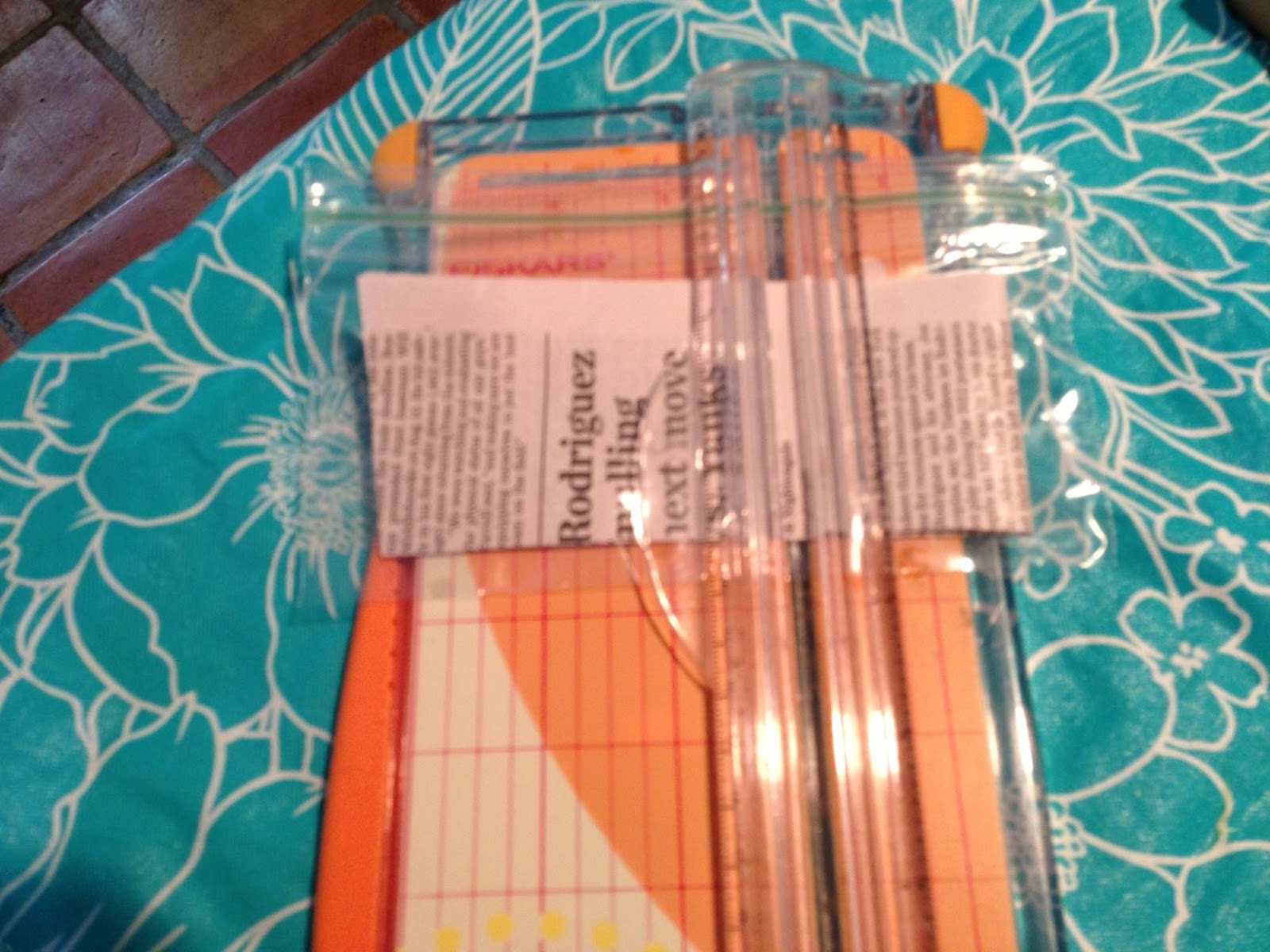
1. Start by flattening out your baggy. I slipped a piece of newspaper into my baggy to make it easier for you to follow what I'm doing. That said, it's MUCH easier to cut your baggy if you insert a piece of newspaper or waste paper as I've done here, because it gives the limp baggy some shape.


2. Now use your Fiskars personal paper trimmer--you do own one, don't you?--and position the bag to cut it. TIP: You will snuggle the top of the bag, with the "zipper," up against the guiding edge of the trimmer. TIP: Start your cut from the "zipper" down, NOT from the thin edge of the baggy up. If you start from the "zipper" down, the rest of the bag won't bunch up. NOTE: You could also use scissors. If you do, be careful!

Note that the green "zipper" is flush against the top edge of the trimmer. 


3. Cut the baggy into two or more smaller baggies. Remember--Take the blade up to the top of the baggy, by the "zipper" and cut down to the thinnest part of the baggy.


4. You'll now have two or three smaller baggies--but their sides aren't sealed! Hey, we can fix that...
Cut pieces of tape as long or longer than your baggy (measuring from the "zipper" to the bottom). Set these aside. You'll need one piece of tape for each open side. So, for three baggies, you'd need four pieces of tape. I used masking tape here so you could see what I was doing.

5. Attach the tape to an open side of a baggy--BUT position the tape so that it's half on the open and half off the open side. See below...

Notice that the tape is half on and half off the open side of the baggy. In other words, if the tape is 3 inches wide, 1 1/2 inches of the tape is stuck to the baggy and 1 1/2 inches is unattached to anything!
6. Flip your small baggy over. Fold the extra overhanging portion of the tape over to seal the other side of the baggy.

7. Press the two sides of the tape together to make sure you get a good seal. If the tape overhangs your new baggy, trim it--but be careful not to cut into the plastic baggy.


The tape is folded over to seal the open edge of the small, new baggy.
8. If you chose to cut the baggy into three smaller baggies, you now have two more baggies to seal up. One (the baggy cut from the middle) will be open on both the right and left sides. Tape both those sides closed.

Here are your three baggies--the one cut from the left, the middle one with two formerly open sides, and the right one (which is flipped over in this photo).

9. And here's the big question...what will you put in your baggies?

On the left, I have plastic "leather" and a seashell, in the middle are bells, and on the right are charms. These baggies were "sealed" with clear packing tape. At the top of the picture, you can see the baggies I made and "sealed" with masking tape. I prefer the clear tape because the entire bag is then see-through.


So tell me, what's in your baggy?

Sally and I want to know!

How cute is this? Two emery boards in the package, but we LOVE the graphics most of all


We'll send these darling emery boards to the person with the coolest answer! 

You have until Sunday September 1 at midnight to answer...and we'll post the winner on Monday!

Tuesday, July 30, 2013

You Could Be a Guest at Sheila's Wedding!


I'm knee-deep in the edits to Group, Photo, Grave, the seventh book in the Kiki Lowenstein Mystery Series (Release date: Fall 2013). Every book has its hard parts and its easier components. I've found that I've really enjoyed describing Sheila's wedding. Here's a taste of it--and remember--you can become a guest at her wedding by entering the Rafflecopter contest! 
* * *

My mother-in-law Sheila’s wedding wasn’t totally ruined by the discovery of a corpse in the catering tent. After all, the ceremony itself had been lovely.
Despite her broken collarbone, Sheila had beamed with happiness as she and Robbie Holmes repeated their wedding vows, while standing before a rabbi and a priest. The day was beastly hot, but the sun was bright in a cornflower blue sky, and a light breeze carried the scent of roses in the air. All in all, a wonderful omen for the new couple. I hoped the photographer, who went by just one name—“Vincent”-- was taking lots of pictures because the scene was glorious. Sheila’s attention to detail had paid off handsomely. The dresses of the bridesmaids were a lovely visual counterpoint to the vibrant pinks, deep reds, rich magentas, and royal purples of the garden owned by my landlord, Leighton Haversham.
My thirteen-year-old daughter Anya and I were Sheila’s maid and matron of honor, respectively, so we wore dresses in shades of soft pink with navy trim.  The rest of the bridesmaids, Sheila’s best friends, wore plum-colored silk. Ester Frommer from Los Angeles, Toby Pearlman from Palm Beach, and Leah Ginsberg from Chicago had pinned narrow navy ribbons to their chests in remembrance of a fourth friend, Miriam, who had recently died. Sheila had a ribbon, too, but hers was more discretely tucked into her bouquet so as not to ruin the lines of her dress. The quintet had been best friends since their years at the Charles and Anne Lindbergh Academy, known locally as CALA, the same school my daughter now attends.
On the groom’s side, we had Sheila’s new husband, St. Louis Police Chief Robbie Holmes; his best man and my husband-to-be Detective Chad Detweiler; Detweiler’s partner Detective Stan Hadcho; Lieutenant Milton Lesher; Sergeant Donald Tomatillo; and Captain Prescott Gallaway. Prescott was a nebbish that nobody liked, but as I understood it, he and Robbie were somehow related. The man was also Robbie’s second-in-command at the police station, so an invitation had been mandatory. I knew that Sheila didn’t like him, but she wasn’t in a position to complain, because Robbie’s side of the invitation list was embarrassingly short. It seemed that his kids had decided not to attend their father’s second wedding. Since Robbie’s first wife, Nadine, had died ten years ago, I found their behavior puzzling to say the least. I mean, come on! At fifty-nine, didn’t the man deserve another chance at happiness? I thought he did.  
His face reflected that with or without his adult children’s blessings, Robbie Holmes was a happy man. When he and Sheila turned to face the crowd as for the first time as man and wife, I thought his grin would split his face in half. Sheila looked radiant as joyful applause drowned out the music of the string quartet playing Pachabel’s Canon in D. The bride and groom made a handsome couple as they started arm-in-arm down the flagstone path. My mother-in-law’s denim blue eyes and silver-white hair were set off by her periwinkle gown. The navy blue sling that kept her broken collarbone in place contrasted nicely with her dress. Robbie looked especially dashing in a newly designed navy blue uniform that signified his position as Chief of Police for the City of St. Louis.
The newlyweds’ expressions were priceless. But when I looked around, I didn’t see Vincent and his camera. I couldn’t whip out my own point-and-shoot and start snapping shots, because I was part of the wedding party. But I could start daydreaming about the wonderful wedding album I planned to create for my mother-in-law.
My name is Kiki Lowenstein and I’m a scrapbooker. It’s my hobby, my passion, and soon it’ll be my business because I’m finalizing the arrangements to buy Time in a Bottle, a scrapbook store where I’ve been working. I’m Anya’s mother, Sheila’s daughter-in-law through my marriage to her late son George, and I’m also expecting Detweiler’s baby. So while my mother-in-law and her new husband took their first stroll as man and wife, I started daydreaming about my own upcoming marriage to Detweiler
As per our rehearsal instructions, my honey and I waited until the happy couple reached a half-way point on the flagstone path before we linked arms and stepped forward together. Next Anya and Hadcho stepped off with Gracie, our harlequin Great Dane, trotting along between them. Around my dog’s neck was a wreath of silk flowers, matching our bouquets of white Shasta daisies, pink Gerber daisies, sprigs of lavender, and pink roses. Two-by-two, the rest of the wedding party processed away from the chuppah, the ceremonial canopy that’s a standard feature of Jewish weddings.
As we moved past the seated guests and spilled onto Leighton’s lawn, I caught a glimpse of my friend Cara Mia Delgatto, who was catering the wedding banquet. She’d been waiting for this moment. Now she raced off to tell her servers to start circulating with flutes of champagne and bubbling non-alcoholic white grape juice. Other members of her staff would add the finishing touches to our food before setting it out buffet-style.

Yes, everything was going according to Sheila’s plans. Even though she’d been immobilized in a recliner with her broken collarbone, Sheila had polished every bit of the ceremony to a high gloss of perfection. From the handmade invitations I’d created and assembled to the wisteria and roses running up the poles of the chuppah, she’d taken care so that the colors, sounds, and fragrances would evoke a wonderfully romantic ambiance. 
More to come...

CONTEST

Just go to http://bit.ly/12d1Xwm to read all the rules!

Be sure to tell me what YOU'd bring Sheila for a wedding gift!


Copyright 2013 Joanna Campbell Slan/All rights reserved.

Sunday, July 7, 2013

How to Get Started Writing Your Book


Recently a friend wrote to me with this question: I want to write a novel, but where do I begin? Do I start with an outline? With a character list? Or do I just plunge in and start writing?

That's a great question, and one that I struggled with for years.

The answer has to do with a scene from The Wizard of Oz...

Remember? Dorothy is on her way to Oz when she comes to a fork in the road. The scarecrow tells her that either route will work. Or in this case, any of the three routes would work.

Here's what I do--and have done for twenty-plus novels:


  1. Start with the first three chapters, drafting a narrative. I get these down fast on my computer. This allows me to nail down the voice and get an idea of who the main character is. I learn as I write, so as I'm writing I get to know my characters. This also helps me figure out how strong the urge to write this particular story is.
  2. Stop and switch to writing by hand. I work up a list of characters and generally take notes about ideas. I like to do this by hand because it un-links the process started at the computer. That's important. Sometimes you want to continue at the computer, but other times, if you don't un-link, you can't get clarity. TIP: At the top of the list of character names, I put an alphabet. As I name characters, I mark off the first letters of their names on the alphabet. Otherwise I'd duplicate first letters in names, and that's annoying to readers. 
  3. Go back to the computer and add to my first three chapters, because now I'm feeling more sure of what I'm writing. (Again, if the urge to write fails, that means this might not be the right time for that particular book. Or I might just need more chocolate. Or a deadline.)
  4. Move to Scrivener or to index cards. As fast as possible, I put down all the scenes I can imagine/think of. When I'm done, I arrange these in order. I look for holes. I fill in the holes. These become my outline.
  5. Print out my outline.
  6. Keep writing and adding to the chapters, using the outline as a reference.

Okay, in my next post, I'll talk about how I manage my manuscript. It's rather an art to keep it under control. I think that's where a lot of beginning authors go wrong, actually.

Until then,

Write on!

Joanna

PS Any questions? Let me know...