Joanna Campbell Slan has moved, searching new blog...

Tuesday, October 9, 2012

'The Action in Publishing is Ebooks': An Interview with Lee Goldberg


By Joanna Campbell Slan

Note: Lee is one of the guests at the upcoming Love is Murder conference in Chicago. He's also the author of too many books to mention, as well as being a TV scriptwriter and producer. Visit him at www.LeeGoldberg.com

**

You’ve spoken candidly about your decision not to “ghost-write” any more Monk books. What would you tell any writer considering work-for-hire? Is it ever a good idea, and if so, why? If not, why not? What pitfalls can you tell people to avoid?

The Monk novels are not “ghost-written.” My name is on the cover. Ghost writers, by contrast, are not credited and do the actual writing for the person whose name is on the cover. But while I write every word of the books, I don’t own them. The rights belong to USA Studios and Andy Breckman, who created the show. At this point in my career, in this fast-changing publishing world, it doesn’t make any financial sense for me to write books that I don’t own. For a new writer, though, taking on a tie-in can be a shrewd move…introducing your name and your talents to thousands of readers. You get to ride on the coat-tails of an established franchise. My brother Tod was an established author of literary fiction when he took on the Burn Notice books. He sold more copies of his first Burn Notice novel than all of his previously published books combined…and saw an immediate bounce in sales of his backlist. He quit writing the Burn Notice books when the drawbacks (two books a year, small royalty, non-ownership, etc) outweighed the benefits. To learn more about tie-ins, and the business behind them, check out the book Tied In, which you can find on Amazon.

You were published very early, but never saw a dime from that first book. A lot of people get overly excited when offered a contract and jump at the chance to be in print. What would you counsel them?

You can’t really compare my situation thirty-some years ago to a new writer being offered a contract today. The business has radically changed…and is still in the midst of turmoil. 

The benefit of taking a contract -- from a known, reputable publisher -- beyond just getting some money is the opportunity to have your work professionally edited and marketed, to have it reviewed by respected publications, to become eligible for membership in professional organizations (SFWA, MWA, Authors Guild, etc.) and awards, etc.

For the time being, it still means something, it still has cache, to be published by publishing company. But financially, it might not be the best move…because you are likely to get a lousy advance and, for all intents and purposes, be trading ownership of your book forever.

The action in publishing is moving to ebooks, and there’s very little these days that publishers can do for you that you can’t do for yourself self-publishing (with the possible exception of the Amazon Publishing imprints, which have the benefit of being able to promote your book aggressively on the Amazon site and directly to its customers). You will own the book and the royalty rate is far, far better than anything publishers can offer you. However, if you self-publish, and if you want to do it right, you will need to hire a great content editor (i.e. ex-editors from major publishing companies) and commission a terrific cover, so your book will read as well, and look as good, as the stuff coming from major publishing houses. That will cost you money. Whatever you do, however, NEVER go to a company like Authorhouse (or their other imprints), Tate Publishing, etc. They are scams that prey on an aspiring author’s desperation and naiveté that will empty your bank account and, worse, eat up a huge chunk of your sales…assuming you ever get any through them, which is highly unlikely.

It costs nothing to have your book published as an ebook on Amazon or as a paperback from CreateSpace. The cost is in hiring the editor and cover artist. Take on that cost yourself personally, not through some third party that offers to do it all for you for a steep price. You will not only lose money now, but future royalties, too

Probably because of your work in TV, your books move swiftly. They are incredibly cinematic and crisp. Any tips on how to keep a manuscript tight? How do you plot? What’s your process?
Writing murder mysteries is, by far, the hardest writing I've ever had to do. It’s not enough to just tell a good story, you also have to come up with a challenging puzzle. It's twice as much work for the same money.
There is no right way to devise a murder mystery. For me, it never starts with the murder. It always begins with the detective, especially if the story I am setting out to tell is part of an ongoing series.
The idea for the mystery will arise from the personality of the hero, and what aspects of his or her character I want to explore, what arena (a place, industry, sport, culture, etc.) I want to put him in, and finally what kind of conflict I think will best bring all of those aspects together and give me a narrative engine for my story.
Once I have that, then the broad strokes of the murder will come quite easily, because it’s an organic part of the story, one that serves to create conflict and reveal character, rather than just a clever device, a really cool idea for a murder, in search of a story to put it into. Often at this point I will discover the story’s thematic through-line  -- what the story is actually about -- that will be in every scene and expressed, in some way, in action or dialogue or attitude, by every character.
Now I can get into the nuts-and-bolts of figuring out the clues, and how the hero will discover them.

At that point, I beat the story out the same way I would an episode of a TV show. I create a “beat sheet,” a few lines about each scene and the key conflict/story point that justifies the scene. If the scene doesn’t reveal character or movie the story forward, and if it doesn’t crackle with conflict, I cut it.

The Walk was frightening, funny, and poignant. It’s the story of a man who survives the “Big One” in LA and decides there’s nothing more important than getting home to his wife. Having only met you once, I wondered, “How much of Lee Goldberg is in the protagonist?” How much of Lee Goldberg is in any of your characters? What inspired that book? Did you ever have a similar life experience with the California earthquakes?

I’ve lived in California all of my life, so I have been through a lot of earthquakes, particularly the on in 1994 that destroyed my house. The idea for The Walk came to me while I was producing an episode of the TV series Martial Law on location in a terrible section of downtown Los Angeles. As I was standing there, I thought how horrible it would be for me if the “Big One” hit at that moment. And the more I thought about it, the more I realized I had a great premise for a book. The only things that reflect me in The Walk are that the hero is in the TV business and lives in a gated community in Calabasas. Other than that, I made it all up.

Why should a fiction reader buy a copy of your book Successful Television Writing? What can the average fiction writer learn from writing for TV?

The fundamentals of character-based story-telling, of generating and sustaining different kinds of conflict, and the key principles of the four-act structure, as well as examples of “beat sheet” outlines, are laid out in the book. You can use those same skills and principles in your novel writing. I certainly do.  Television writing is tight…you only have 42 minutes to tell your story. Character is revealed through action and dialogue. The pace is unrelenting. Those are all great qualities to have in a novel, particularly a mystery or thriller.

Your short stories end with wonderful unexpected twists. Any suggestions on how you come up with those “out of the box” endings? Any tips on short story writing?

I’m not really much of a short story writer. I think I’ve done four or five in my entire career. But when I do write one, I try to make sure I have a strong central conflict and a satisfying pay-off. Too many short stories are vignettes that, for me, feel pointless. I want a short story to deliver a strong emotional or visceral punch.

King City is full of contradictions. The protagonist decides to pursue some crimes, and walk away from others. He’s very much a Lone Ranger in his approach. How did you come up with him? Where did you come up with the various scenarios he’s forced to face? Did you talk a lot with cops or is this all your imagination?

I broke both of my arms in a bad accident a few years ago. Part of my recovery involved having my rebuilt right arm strapped into a nasty device from the Tower of London collection that bent and extended my arm for hours each day. During that time, I watched hundreds of hours of Gunsmoke reruns and was surprised by how much I enjoyed following stoic, leather-skinned Marshal Matt Dillon bring order, and sometimes justice, to lawless Dodge City.
Matt Dillon truly lessened my pain. There’s just something about westerns, about the simple concept and mythic characters of Gunsmoke in particular, that’s inherently compelling and deeply satisfying. I wondered what it was, and if I could capture it in a crime novel. So I studied the show and scores of classic western movies.
I discovered that it’s a lot more than just giving a guy a Stetson, a badge, and a gun.
A western puts a man in a lawless, unforgiving, brutal frontier, where he must somehow survive by living off the land, his wits, and his own rigid code. It’s that last bit, I think, that is the core of it all: a personal code of conduct that’s constantly, relentlessly, put to the test.
A true western character ultimately prevails against adversity because of a stubborn, unwavering faith in his own convictions and the righteousness of his cause, a determination to see the world shaped the way he wants it to be, rather than let himself be shaped by it. He doesn’t try to explain or justify himself because it’s pointless. His actions speak for him.
And as iconic and old-fashioned as that all may be, it’s so refreshing in a world where everyone, particularly heroes in crime fiction, are so self-aware and self-obsessed, so eager to accept the moral, ethical, professional, legal ambiguities in a situation rather than take a principled stand on something, regardless of whether it’s right or wrong to everyone else.
That led me to write King City, and to create Sgt. Tom Wade, a man of principle, whose values may be laudable but whose maddening, unwavering loyalty to them costs him almost everything and everyone that he cares about. He’s not out on the western frontier, but exiled to the worst part of a once great industrial city, where he is out-numbered and out-gunned, and must enforce the law on little more than sheer strength of will.
Viewing the tropes and clichés of a modern crime novel through the prism of a western gave me a fresh perspective on the genre that made the book a pleasure to write and, I hope, to read.
I relied on a few cop friends – Paul Bishop, Lee Lofland, and Robin Burcell – for advice and some facts, but mostly I made everything up based on my own experience writing cop shows and novels.
You spoke at Sleuthfest about a book you wrote that never earned back its advance of $1500, but that you’ve since re-released as an e-book, and that has gone on to earn $80,000. Please tell us about that—and about what you see as the future of publishing. Do you still want to work with legacy publishers? What direction are you taking your career? Is it possible that this direction is open to you because you’ve already build a following?

That book was The Walk … which was a bomb in print but has been a huge success for me as a self-published ebook. There’s no question that most of my initial success self-publishing came from having an established name, a large backlist, and lots of current titles in print. I had a pre-existing platform to build upon. Scores of midlist authors who were dropped by their publishers, or saw their entire backlists go out of print and thought their careers were over, are enjoying huge success now self-publishing their books. In fact, I know lots of midlist authors who are earning more from their books today than they did when they were originally in print. Amazon’s KDP platform…the ability to put your books on Amazon for free…changed everything for authors. I know authors who are turning down three-book contracts from “legacy” publishers because they can make far more money, and have much more control, self-publishing their books. And I know authors who have actually bought their backlists from their publishers, for as much as $50,000, and earned out on that investment within as little as 90 days.

There isn’t a lot that a legacy publisher can offer a midlist author in return for their massive share of the royalties and what essentially amounts to permanent ownership of your book…which is why you see guys like Brett Battles, Paul Levine, Blake Crouch and Joel Goldman moving into self-publishing and enjoying enormous creative and financial success.

Unless you are a major league author – a Janet Evanovich, James Patterson, Michael Connolly, Stephen King, John Grisham, Nora Roberts etc. – it doesn’t make a lot of sense to work with a legacy publisher anymore, not unless they radically change the way they do business and their relationships with authors, which doesn’t seem to be happening yet. 

For superstar, A-list, brand-name authors, legacy publishers are still the way to go because they have the deep pockets, marketing resources, corporate media partnerships and global distribution to make the most out of their literary franchises.

But that doesn’t mean I am walking away from the Big Six. I recently signed a four-book deal to co-write a series of novels with Janet Evanovich for Random House and I couldn’t be happier to be in business with them.

Wednesday, October 3, 2012

A Very Kiki Contest!


Lately, I've been swamped re-writing and editing the second book in The Jane Eyre Chronicles, Death of a Dowager. Meanwhile, Kiki keeps calling to me, like an invisible friend who is feeling sorely neglected.

So I decided to do something fun...a CONTEST!

The rules:

1.  Tell me what you love about Kiki in an email. (Send it to JoannaSlan@aol.com)
2. Put KIKI in the subject line.
3. The deadline is Oct. 15
4. I'll select a winner at random out of all your comments. That person will appear as a character in the next Kiki book or short story.

All comments will appear on my website, but I'll just use your first name and last initial for privacy's sake.

Okay--let the games begin!

Friday, September 28, 2012

An Interview with David J. Walker

Note: This year again, I'll be interviewing featured authors who'll be attending the upcoming Love Is Murder Conference, February 1-3, 2013 in Chicago. My first author is David J.Walker, the author of twelve mystery/suspense novels, and the creator of the Wild Onion Mystery Series, as well as a new series starring Father Paul Clark. The first book in it is called Company Orders.


David is a past president of the Midwest Chapter of Mystery Writers of America, and he lives with his wife Ellen, just north of Chicago. He has been a parish priest, an investigator for the Chicago Police Department, and a lawyer. Now he mostly sits around and tries to think positive thoughts about the future of the planet. Oh... and he writes nearly every day. 


Special Note: I have an Advance Reader's Copy of David's newest book Company Orders to give away. Be the first to comment on this post and it's yours--just remember to email me your postal address at JoannaSlan@aol.com


1.      I have this theory that those of us who grew up listening to the portions of the King James Version of the Bible have a certain poetry in our souls. Do you agree? Do you feel that the time spent as a priest reciting and hearing these works informs your writing? Do you miss the “old” version of the service that was more poetic?

I’ve had twelve novels published over the last sixteen years or so, and I’m sure that my time spent as a priest informs my writing in many ways—some obvious and some I can’t even imagine. I’m not aware that my proclaiming and hearing Scripture was one of them, but that’s an interesting idea. I should also mention that, although the King James Version is beautifully poetic, in Catholic Church rituals we never used that translation.

As for the “old” version of the Roman Catholic liturgy, do I miss it? Not in the least. These days many are pushing to return to the old liturgy, and I think that’s a step in the wrong direction.

2.      When did you decide to become a writer? You’ve said that you always loved writing. What does that mean? What did you write before you became a writer? And when did you realize that you could be one, too?

I decided to become “a writer” in April, 1991. I remember the exact day. (In fact, it was dark and stormy, as I recall.)

But first…I always loved reading. I was very young when I realized I could be taken out of my world and live in a place and time that was fun and exciting—even dangerous—and where people like me faced incredible challenges…then stepped up and beat the odds.

I believe that’s why in high school I discovered I could write well enough to catch the attention of some of my teachers. And when we get praised for our work, don’t we love it? At least I did…and still do.
While a parish priest I happened upon a “free-lance” job, writing articles for religious publications. It was fun, and I got paid. I liked that, too. I continued to read a lot. Spiritual stuff, of course, but also plenty of fiction (mostly mystery/crime novels).

When I left the priesthood I went to law school pretty much on a whim. It was certainly not an informed choice. I soon discovered lawyering wasn’t for me, and I went to a career counselor (meeting her first on that dark and stormy day I mentioned earlier). “What I’d really like to do,” I told her, surprising even myself a little, “is write mystery novels.” “Really,” she said. “So…why don’t you?” Voila! The trick was learning to rearrange my life so that I could survive while writing.

3.      From a priest to a cop to a lawyer. Sounds like a tour de force of the best and worst in humanity. How do these professions still shape your work? What did you see/learn/feel that has shaped your world view as a writer? When did the stories start to form in your head? And are there stories you’ll never tell?

Actually, I was never a cop. During my four years in law school, I worked for the Chicago Police Department as an investigator in a unit called the Office of Professional Standards. We investigated police misconduct, mostly allegations of the use of “excessive force.” I spent forty hours a week taking statements from police officers, arrestees, and other witnesses; gathering police reports, medical records, photographs, and other evidence; and writing (yes, a major part of the job) findings and recommendations as to whether formal proceedings should be initiated against the accused officers. I should have paid the department for the experience and the inside view of cops and police work.

Roles for police officers and lawyers are common in crime novels, and I often say that priests keep showing up in my books, too, whether I was expecting them or not. I have used lots of bits and pieces of real events and conversations from my various “careers,” but no real stories from real life.

4.      You seem to have a theme of people breaking the rules and feeling they are justified to do so. For example, Kristen knows she shouldn’t break and enter, but she does. Dugan knows he shouldn’t pay cops to steer cases his way, but he does. Paul Clark knows he shouldn’t steal a friend’s computer, but he does. Comment? Do you think rules are meant to be broken? Is there a higher moral authority we should all subscribe to? Explain.

Rules, laws, ethics, morality, authority, behavior…that’s what it’s all about, right? In literature, and in life. Along with honesty, compassion, courage, wisdom, common sense, and the opposites of all those things. And there are so often competing values. Kirsten’s aware that picking a lock is against the law, but she does it, knowing it’s the right thing to do. Dugan’s aware that paying cops is against the rules, but he does it, knowing it’s the wrong thing to do. Paul Clark’s aware that taking his murdered friend’s computer is theft, but he does it, unsure as to whether it’s the right or wrong thing to do.

Is there a higher moral authority we should subscribe to? Yep. Can I explain? Uh…well… Maybe a few “rules of thumb for the private eye” would be a start:
When in doubt, lean toward the little, the weak, the outsider, the accused.
When “everybody knows” something is true, maybe it’s not.
Getting paid is good; righting a wrong is better; doing both is best.

5.      You have been open about thanking your writing critique partners, and about saying they’ve leveled some pretty tough criticisms your way. What have you learned from them that you use in your work? Were there any bad habits you needed to break? What skills do you have now that you owe to them?

The group I meet with has been a big help, particularly in matters of style and clarity. We have found it’s best to be honest but gentle in our critiques. A few examples of how the group helps? I like to put lots of humor in my books, especially with Kirsten and Dugan in my Wild Onion books, and the group tries to keep me from being too cutesy.  Or I’ll write a scene that’s perfectly clear in my head, and I think it’s clear on the page, but the group says: “Huh? We don’t get it.” I might write some incident I actually saw, and they’ll say: “So what if you saw it happen? It ain’t plausible.” Lastly, and this may be the most painful (read: “most useful”) criticism for me, is when I pour out my heart and someone says: “The writing is great, but this scene…what’s the point?”

(By the way, the group makes suggestions, the author accepts them or not.)

6.      What adjectives would you use to describe your character Paul Clark? What sort of character arc do you see for him?

Paul Clark is the protagonist in my latest novel, Company Orders. He’s a Chicago priest. He’s a good man, true to his obligations and to his calling. But he’s also ambitious. He wants to rise up through the ranks and be a bishop, be in charge of a diocese. He’s right on track, too, until he runs into a problem from far left field. Someone’s life is at stake, and Paul makes a deal with the devil…or with someone equally dangerous, a CIA agent. Paul’s always been good at preaching about love’s sacrifices, now he’ll find out what it’s like to live them.

7.      What is your process? Your books switch back and forth with point of view in a very complicated way. How do you plan your work? How do you decide who gets to tell his/her side of the story?

If a book needs multiple points of view, I generally change POV only when I start a new chapter. In the Wild Onion books I split the POV chapters between Kirsten and Dugan, but try to keep in mind that Kirsten’s the star. Dugan’s fun to write, but he’s basically a sidekick. I keep a chapter-by-chapter running outline as I write, and one thing I note is whose POV that chapter utilizes. If I look back and see it’s been too long since I’ve done a chapter from a certain character’s POV, I try to figure a way to get that person back in the spotlight.


8.      What parallels do you see between the sex abuse scandals in the Roman Catholic Church and the Jerry Sandusky case at Penn State? From your unique vantage point as a former priest and a writer, what would you say about motivations and the preservation of the brand in each situation?

There are obvious similarities, notably that both situations involve institutions led by people who’ve been handed too much power, and are too anxious to hold on to it. People are oh-so-willing to give allegiance, almost worship, to heroes (or “important people”), and then are oh-so-disheartened and outraged when those heroes turn out to be just broken human beings who sometimes do terrible things, and/or cover them up. And aren’t we all broken…more or less?

9.      You do a masterful job with dialogue. Any secrets you’d care to share with the rest of us?

There’s an awful lot that could be said, but I’ll stick to these three rules: one, read everything Elmore Leonard ever wrote; two, take all of the dialogue you write and read it out loud (to yourself or, better, to your critique group) and then rewrite it and punctuate it the way it ought to sound; and three, forget the way people talk in real life, which is usually dull and boring and wordy, and write the way people talk in Elmore Leonard books, which is always cool and exciting and brief. 

**

Be sure to visit David at http://www.davidjwalker.com/

Friday, August 17, 2012

Feight--A Zentangle Pattern


As some of you know, I've been certified as a Zentangle teacher. It's the most fun I've ever had with a craft. Probably, in part, because it's so incredibly portable. I can take my tangle stuff with me anywhere!

At night, when I'm done with my writing, I sit down and tangle. This particular design came from a "mistake" one of my students made. See, in the world of Zentangle, there are no "mistakes" only "creative opportunities. And he made one. And I went home and thought about it...and voila!

Feight is a beautiful tangle, I think. Easy to do. Very delicate. I hope you like it!

Can you guess where the name comes from? Hint: Pronounce it "Fate."

I combined "Figure" and "Eight" to become "Feight," and I love the sort of metaphor the name creates because a figure eight is also the infinity sign.

You'll also see another tangle, a very simple one, I call "Phrill." Yep, it's probably so simple it might not even BE a tangle, but who cares? I like the gentle curves.

To see the "step out" better, just click on the image.

Friday, May 11, 2012

Remembering My Mother

My sisters often send me photos of my mother's grave after they add new flowers. I appreciate the fact that my sisters are tending Mom's grave, but I hate those pictures, and I haven't found a way to tell Jane and Margaret my feelings until now. See, I don't want to remember my mother by visiting her grave. Yes, we picked a lovely spot in Port Salerno with a view of the water. Yes, it's an Episcopal church's graveyard, which would have pleased her. True, my sisters did a wonderful job of designing Mom's stone, including the ascending dove image, one just like the one she always wore on a silver chain. But that's not where my mother is. That piece of ground has little--or nothing!--to do with Mom, and certainly it's not how I choose to remember her. When I want to remember my mother, I dance. My mother was a ballerina who danced with the New York City Ballet, and the Atlanta Civic Ballet. She taught ballet all the years we lived in Vincennes, Indiana. My earliest memory is of her lifting up and over the broken glass in the door to her studio in Jacksonville, Florida. She'd locked herself out and to gain entrance she'd broken the back window. I guess she must have been desperate to get in because she was expecting to teach a class. That's all I can figure, given the rearview window distortion of memory. So when I think of Mom, I don't think of a static plot of grass. I think of her physical grace. I think of how triumphant she looked after completing a series of demanding fouette turns and how she often spoke choreography out loud when listening to music. I see the beautiful lines of her arms, the quicksilver way she translated music into rhythm, and the longing she carried with her, a longing that found its expression in dance. When I miss my mother, I don't visit the graveyard. Instead, I dance. As I turn and twirl and leap, I "talk" to Mom. "See? You aren't dead. You live in me!" I tell her this to reassure her; she was very frightened of dying. I remind her how she lives on. Because that's the essence of parenthood, that knowledge that we will go on, that we will live on in some small part because we were brave enough to have a child. And so she does. She lives in me, and she is most alive, and she is eternal when I am dancing. This Mother's Day, I challenge you to think of how your mother lives on. And instead of visiting a graveyard, I hope you choose to honor your mother in some activity that proves her love is eternal.

Wednesday, April 11, 2012

Lucky 13 -- Thirteen Kindle Reads FREE Only on April 13!

By Joanna Campbell Slan


To celebrate the release of Ready, Scrap, Shoot, the fifth book in the Kiki Lowenstein Mystery series (aka “Scrap-n-Craft Mystery series”), I wanted to do something really special. Something fun, something extra for my fans. So I’ve joined together with a dozen other mystery writers, and we’re turning Friday the 13th into a lucky day for anyone who loves to read. Yep, today you can download thirteen great reads for free on Kindle.


One of the reads is a short story featuring my protagonist, Kiki Lowenstein. I named it “Kiki Lowenstein and the Purple Passion,” and it’s been getting five-star reviews on Amazon.
Is it lucky for you? Undoubtedly. You’ll get to load up your Kindle with a fresh crop of books (and a short story!). If you don’t have a Kindle, you can load the app onto your computer for free.

Will it be lucky for me? I dunno. It’s a brave new world out there for authors with the advent of so many ways for readers to access our work. Since all thirteen of us are pitching in to promote our reads, I’m sure I’ll attract at least a few new fans.

So why not check out these thirteen offerings? And let me know…does this sound like a good promotional idea to you? Why or why not?
**


Sink or Swim by Stacy Juba- After starring on a hit game show set aboard a Tall Ship, personal trainer Cassidy Novak discovers that she has attracted a stalker. Can she trust Zach Gallagher, the gorgeous newspaper photographer assigned to follow her for a local series? As things heat up with the stalker and with Zach, soon Cassidy will need to call SOS for real. "Easy read and extremely well written." Stephenie LaGrossa, Survivor; "I could not put this book down." Book Club Queen


Darker By Degree by Keri Knutson - A missing girl. A mysterious break-in. A brutal murder. Actress Maddie Pryce is looking for her big break, but finds herself at the center of a series of seemingly unrelated crimes. Soon she’s tangled up with a persistent detective, a driven director, a playboy producer, and an unstable ingenue. Can Maddie unravel the clues before her next role is as a serial killer’s victim?


Diary of Murder by Jean Henry Mead - Dana Logan's wealthy sister, Georgi, dies and Georgi's husband claims it was suicide. Dana knows her sister would never take her own life and sets out to prove it was murder, with her friend, Sarah Cafferty. During their investigation, they stumble over more bodies and place their own lives in jeopardy when they encounter a vicious drug ring.


Ghost Island by Bonnie Hearn Hill - Is Aaron a dream, or is he something much more deadly? Livia Hinson has just begun a Seminar at Sea when a storm hits their boat. Now, she is stranded with the other students on an island off the coast of California. Far away from her foster home and her heartbreak, Livia finds Aaron, the perfect love. But the only way they can be together is in her dreams.


One Small Victory by Maryann Miller -the story of one woman's courage. Suspense novel by Maryann Miller, based on a true story of a woman who infiltrated a drug ring and helped bring down a major distributor in her small Texas town. Don't discount what a mother can do to protect her children. First published in hardback, now available as an e-book and as a trade paperback.


Rock & Roll Homicide by RJ McDonnell - The 1st novel in the Rock & Roll Mystery Series finds PI Jason Duffy helping the widow of a slain rock star after she climbs to #1 in the police suspect charts. Duffy, an inexperienced former club musician, sorts through suspects ranging from band members to the Russian Mafia in this rocking whodunit. 4.67 Star Average.


Southeast Asian Quartet by William S. Shephard - Suspense and murder in Southeast Asia in the style of Somerset Maugham, these four tales evoke Singapore, Borneo, Malaya and Indochina. Perhaps you'll solve the disappearance of Jim Thompson, the Thai Silk King, missing for 35 years. Draw up a chair at the Raffles Bar and join us!


Taken by Debra Lee - Welcome to the fictitious little town of Watery, Pennsylvania where the district attorney’s personal secretary, Mary Murray never planned to become a single mom or a suspect in her infant’s disappearance, but she plans to find Jena before she suffers the same fate Mary’s younger brother had when he was taken twelve years earlier.


The Four Last Things by Timothy Hallinan - Hired to follow a young woman, private eye Simeon Grist becomes mired in murder and a million-dollar religious scam in The Four Last Things, the first in a series of highly-praised LA private-eye novels written in the 1990s by 2011 Edgar nominee Timothy Hallinan. The Drood Review called it “One of the 10 best books of the year.” Publisher's Weekly: “Very satisfying;” Booklist: “a sure winner.”


When a Man Loves a Woman: Enhanced Multimedia Edition by Alina Adams - Can a man and woman ever truly be just friends? What about if one of them is married? What if one of them suddenly isn't anymore? Originally published as a paperback by Dell in 2000, the 2011 e-book re-release multimedia edition now features all the text of the original, plus a bonus musical soundtrack to compliment the story! A romance from mystery author Alina Adams.


Willowtree: A Bruce DelReno Mystery by Mike Bove - Bruce DelReno, retired postman, golf and food nut, finds a body near the golf course. He believes the murder is connected to others and involves his Apache friend. Together, they stay a step ahead of the police in trying to solve the cases. They uncover dark secrets of a close knit group of friends in the town of Willowtree, Arizona. This is a fun read with some interesting characters.


Kiki Lowenstein and the Purple Passion: A Kiki Lowenstein Short Story by Joanna Campbell Slan - When a customer’s daughter is falsely accused, Kiki Lowenstein foils a nasty plan to ruin the girl’s reputation. Mystery, crafts, recipes, humor, romance/short story.


Whispering by Gerrie Ferris Finger - Will Cleo Snow admit to making love with charming World War I fly-boy Graham Henry to

clear him in the disappearance of an island woman who claims he plans to marry her? Will Graham compromise Cleo to clear himself? With her spirit firmed by deceit, Cleo vows to uncover the truth and keep her secret.


Please mark your calendar for Give Your Child a Free Kindle Book Day on April 19 - in which numerous books for children, pre-teens, and young adults will be free.

Monday, January 9, 2012

Keep It Spare and Lean: An Interview with Chris Grabenstein

Note: Chris Grabenstein will be one of the Guests of Honor at Sleuthfest, March 1 - 3, 2012. He's the author of the John Ceepak series, for which he won the Anthony Award for "Best First Mystery."

JCS:  Chris, I know that unlike most authors, you didn’t just get a wild idea and start writing. Before you started your Cepak series, you studied James Patterson’s success. What sorts of decisions did you make? How have they worked for you? (I recall you talking about the titles that were all of the same ilk.)

CG: Well, sometimes, I just get a wild idea and start writing. However, when I first contemplated writing a mystery, I did approach the task the same way we used to go after a new campaign in advertising. What could I do that would be different in a world cluttered with seemingly millions of sleuths? How could I make a character stand out? This was the same exercise we always went through when developing a new TV spot -- how do I break through the clutter? How do I make someone not click the remote and zap my commercial?

Having worked with James Patterson at J. Walter Thompson advertising, I remembered his breakthrough coming with the creation of Alex Cross and a series of books titled after lines from nursery rhymes. ("Kiss The Girls," "Along Came A Spider," etc.) I set out to attempt to do the same thing. I had the title TILT A WHIRL before I had anything else. I knew the second book could be called MAD MOUSE or MIND SCRAMBLER. The books would all be named after amusement park rides...and the title rides would act as metaphors for what happened in the stories. To avoid the Cabot Cove syndrome ("Murder She Wrote") I set my series in a tourist town that could easily have a transient population and a new cast of victims and killers every week of the summer.

Then I needed to create a sleuth unlike any the world had seen. That's when I came up with the notion of an overgrown Eagle Boy Scout who will not lie, cheat or steal nor tolerate those who do. He seemed to be the polar opposite of the boozing, depressed, divorced, no-code-but-my-own, noirish heroes populating so many mystery stories -- the dark knights I still love. I created John Ceepak to be different.


JCS: How did you come up with the name “Cepak”?

CG: I came up with Ceepak after going to a wedding where one of the groomsmen, a former soldier, was named Ceepak. And all of his buddies called him by his last name. If you hang with a group of guys, there is usually one who doesn't seem to have a first name. I was always "Grabber" in high school; never "Hey, Chris," always "Hey, Grabber." You'll notice that very few characters in the stories ever call John Ceepak "John." And Danny Boyle is always "Danny." It wasn't until the third book that someone pointed out to me that Ceepak's initials were "J.C." Cue the Twilight Zone music...


JCS: Your books are a bit unusual because like the Sherlock Holmes stories, they are told in first person by a secondary character who admires the protagonist. How’s this working for you? Why did you choose to do this? What are the drawbacks and the strengths of this approach?

CG: I tell the stories in Danny's voice for the same reason I think Doyle tells the Holmes stories in Watson's voice: First person narration by our sleuths would have readers throwing the books against the wall in anger. Can you imagine a tale told by the arrogant, conceited, but brilliant Holmes? His brain would move far too swiftly to fill us in on all the little details he'd already deciphered and moved on from. The same with Ceepak. His by the book, just the facts, code-following ways may smack of a goody-two-shoes and Dudley Do-Right if he did the narration. So, I gave the story telling chores to a 24 year old part time cop who, like Watson, admires the master sleuth he is working with. Danny is also a lot funnier than Ceepak...although Ceepak is attempting to develop a sense of humor as the books progress.

I think the device works for this particular pairing -- because of the "lead" sleuth's personality.

The stories are also told in first person present tense...which drives some people batty. I think the present tense helps the action clip along and is how cops tell stories. "We go into a bar. There's this guy with a gun who has his paws all over a waitress. We pull out our service revolvers..."

JCS: Your background is in advertising. What did you learn from advertising that you apply to your work in novels? Your writing is very spare, with no wasted words or overlong descriptions. Has the art of brevity, which is key to advertising, ever been a problem when working on books?

CG: Yes. Right. We ad folks write tight. They used to tell us to keep a copy of a Hemingway book in our desks. Keep it spare and lean and don't waste time on the stuff nobody wants to read anyway, to paraphrase Elmore Leonard who, I think, also has a background in advertising. The biggest thing I learned in advertising came from James Patterson, who was my creative director: Hit 'em with a pie in the face and once you have their attention say something smart. Remember, nobody wants to watch TV commercials or stop listening to music on the radio to hear your ad or quit flipping through Kardashian Wedding updates in People magazine to gaze upon your glorious print ad. We learned to give readers/viewers a reward for their attention. Interestingly, when I was published by Carroll & Graf, the publisher told me, "I like advertising writers. You don't waste people's time." I guess that's because we only had thirty seconds (70 words max) to grab someone's attention and then convince them to go buy whatever Whopper we were selling that month.

Has it ever been a problem? I hope not. But, I try to write the kind of books I love to read: page turners that can make a transcontinental flight seem like it lasted three minutes instead of six hours.

JCS: Your plots hustle right along. What’s your process? Are you an outliner?

CG: I'll talk more about this at Sleuthfest on the plotting panel. I am a hybrid, I think. I stake out four key plot points, as if I were scripting a two hour, two-act movie. I then know where I have to be at a certain word count and work toward that goal. It help keeps things focused...but I make up what happens in between the plot points on a day-to-day basis. I also overwrite like crazy. My 75,000 word Ceepak novels tend to have first drafts that are 90,000 words long. Then I go back and chop and prune.

JCS: You’ve had such a successful career as a writer. What sort of advice could you share with others just getting started?

CG: First of all, that's very kind of you to say. My advice is probably the same as everyone else's: Read a lot. Write every day. I heard somewhere that it takes 20 minutes to drift off into that "awake dreaming" zone where the real magic starts happening. So, try to sit down for an hour everyday and get 40 minutes of dream time in. Also, and I learned this writing 500 TV commercials for every one that ever got produced, I think you have to LOVE the writing. Not the riches (well, there aren't any of those anyhow), fame, acclaim, awards, snazzy author photo, or cocktail parties with publishers (do they still have those? If so, how come I'm never invited?). The only part of this business you have control over is the words and the process of writing. I absolutely love sitting down every day and getting lost in whatever story I am weaving. I always have, I think. No one can take that feeling away. Everything else? It may never come or it might all disappear. Love the writing...not being "a writer."

JCS: You learned a technique in improv classes that you use with your writing. Would you share it?

CG: Yes, I will. In fact, my afternoon talk on Craftfest Thursday will be an improvisational workshop where I will teach everybody the "Yes, and..." rule of improv. It is a rule I use every day and will help writers get beyond the blank page and into places they never could've dreamed they'd be going. (Okay, that was a thirty second ad for Craftfest. Once an adman, always an adman...)

JCS: You live in New York City. Make us all jealous. Tell us if that has been a boon or a bane to your career.

CG: I think New York is a great place to live as a writer. If I need a crazy character, I go out and walk around the block. I found a major character for my new middle grades caper series on a bus ride uptown one morning. It is nice to be able to go to an MWA meeting in New York and rub elbows with superstars like Lee Child. However, I think writers can live anywhere.

I really think having an agent in New York has been a boon to my career. They go to cocktail parties. They schmooze with editors. They do a lot of lunches. That's how we got the idea to turn THE CROSSROADS from a 120,000 word adult ghost story into a 50,000 word middle grade mystery. My agent bumped into an editor at a party who was looking for ghost stories for middle grade readers!

JCS: Anything you want to tell me?

CG: I'm looking forward to Sleuthfest. I've always heard it's the best "writers" conference. And I can thank Charlaine in person for making me a New York Times best seller (because she and Toni Kellner asked me to do a short story in DEATH'S EXCELLENT VACATION which made the top ten..and not because MY name was on the book cover!)

Visit Chris at http://www.chrisgrabenstein.com/

Wednesday, December 28, 2011

How to Protect Your Library--Books Are Meant to be Loved

Reading to my dogs. Note the "red eyes." Sigh. Am I really demonic?
In this Sunday's New York Times, someone wrote into the Social Q's column with a question that illustrates life as we know it. Seems that "Anonymous in Vermont" had a calamity during the annual Christmas party. Thirty adults and 30 kids were in attendance. Unfortunately, one of the kids puked on Anonymous's e-reader--and ruined it. Now Anonymous wants to know, should he/she ask the parents of Up-Chuck to replace the e-reader?

Since our world seems to be dividing into two camps, those who love e-readers and those who abhor e-readers, I could almost hear the anti-e-reader camp cheering and shouting, "Boo-ya! If it had been a paperback, all would have been fine."

But that's not really true. Without getting too graphic, trust me when I say that if someone pukes on a paper product, it's ruined.

So what's the point here?

I Have Two Great Loves

I love paper and I love my e-reader. They both have their strong points and their weaknesses.

I like traditional books for research because I like to mark them up, use a highlighter and stick Post-It notes inside the book to mark passages I want to revisit. (I know that some of you are shuddering at the thought of marking up a book. My dear friend Chris Clark-Epstein taught me that a book is a resource. She suggested creating my own index in the front of a book so I could quickly find pertinent facts. It was one of those timely suggestions that really transformed my daily life.)

I love my e-reader because it holds so many books, it's easy to read at night (the light that's attached to the cover functions almost like a night light), and books are delivered immediately to me. (Which I admit is my idea of heaven--books that appear magically on request.)

Books Are Made to be Eaten

I once heard an interview with the son of the woman who wrote Pat the Bunny. He suggested that that his mother's book was a mega-seller because...kids ate it. Yes, he admitted that kids loved chewing on Pat the Bunny almost as much as they liked having it read to them.

I've kept all my son's books, and I can tell  you that many of them have been masticated. And yes, one was even puked on. Some have ripped pages. Some are discolored. All have been loved.

Solutions?

Keeping kids away from books is not a solution. Having a library of indestructible kids' books is.

Books are meant to be loved, and handled, and enjoyed. And occasionally...puked on.

To properly protect a kid's book, cover the pages with clear Contact paper. Then you can wipe them clean. Better yet, buy two copies. One for "loving" and one for the future.

I started to write: "Don't give them your e-reader without supervision." But after watching my grand-nephew toggle through my sister's iPhone, I can't suggest that. The next generation won't waste time thinking of books as "either/or." They'll simply accept that books will come in paper or in new formats.

After all, it's the content that counts.

Friday, December 2, 2011

An Interview with Julie James: 'My Writing Process Is My Own'

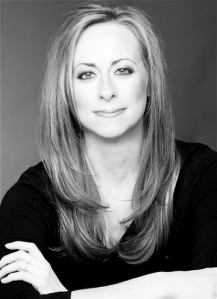
Julie James
My guest--Julie James.

Note: Each year I conduct interviews with famous authors who will be guests at various conferences. Julie will be appearing at Love Is Murder, Feb. 3-5, 2011, in Chicago.)
1. Julie, you were an attorney before you went into writing novels full-time. What is it about training as an attorney that seems to make for such fantastic authors? What did you learn in your work as a lawyer that you still use when you write today?


A. Maybe all us lawyers write simply to escape our day jobs? Kidding! (Mostly.) I think it’s a couple things. First, as a lawyer, you write a lot. Second, as a trial lawyer, your job in many ways is to tell a story—to take the facts and present them in a way that hooks the reader or listener (i.e., the judge or the jury) and convinces them to accept the story as you tell it. Plus, being a lawyer involves many hours sitting in front of a computer. Good training for a full-time career as a writer.


2. In the “traditional” romance novel, the hero and the heroine must be kept apart, usually by misunderstandings. You, however, do a fabulous job of throwing in one crisis after another that keeps your characters apart. Do you plot all this out in advance? How do you keep coming up with believable interruptions rather than the trite “misunderstandings” that blemish a lot of romance novels?

A. I actually find that the Big Misunderstanding isn’t used all that much in romance—at least not the ones I’ve read. From time to time, I’ll see a review of a book that uses the Big Mis as a device, and if it’s not done well readers will call an author out on that fast. That’s not to say you can’t have misunderstandings in a story—of course you can, we have misunderstandings in real life. But if your characters are smart, rational people, you can’t drag out a misunderstanding for too long that could be cleared up by one simple conversation.


In answer to your other question, yes, I do plot out my books in advance. I generally put together about a fifteen to twenty page outline of the book, which I use when writing a synopsis for my editor. But when I’m actually writing the book, I rarely look back at the outline. By that point, the book is developed enough in my head, and I want the freedom to deviate from the outline if that’s where the story takes me.

3. You say you think of your voice as “smart, sexy and sophisticated.” Your characters banter, and they crack jokes in such a way that the dialog reveals a unique voice. How did you find your voice? Do you ever have days when it doesn’t show up for work? If so, how do you reclaim it?

A. LOL, is that what I said about my voice? Apparently, my voice also includes being a little full of myself. : ) I actually wrote screenplays before I began writing novels, and my books certainly tend to be dialogue-focused. My characters are usually somewhat on the sarcastic side. Perhaps a lot on the sarcastic side. And typically there’s a lot of back-and-forth banter between the hero and heroine.

Do I ever have days where my voice doesn’t show up for work? Hmm. . . I’d say not really. But that doesn’t mean I don’t get stumped. Sometimes I’m trying to do something with a scene that just isn’t working, sometimes a plot point isn’t developing the way I want, or sometimes I struggle with getting the tone of a scene right. But my voice, so to speak, is typically there.

4. You went to your first RWA convention prior to becoming a published author. Most folks won’t “pop” for a conference until they have a book. What was your thinking? Was it of value to you? Would you recommend other pre-published authors attend conferences before they have a book in hand?

A. I was pretty unfamiliar with the romance genre until I’d learned from my editor, after selling my first book, that I had, in fact, written a romance. (I’d called the book a “romantic comedy” when we sold it.) So for me, it was valuable to attend the conference simply to familiarize myself with the genre. Also, I think conferences offer great networking opportunities—I met several authors at that first conference with whom I continue to be friends. And there are a lot of helpful workshops at these conferences for both published and unpublished authors—I still attend workshops, even though I’ve written five books and now present workshops myself. There’s always room to learn more.

So bottom line, I think attending conferences can be very valuable, and I do recommend them to pre-published authors—IF it’s financially feasible. Let’s be honest, these conferences often aren’t cheap!

5. You are a big believer that “action speaks louder than words.” How do you come up with the right actions to reveal your character’s inner worlds?

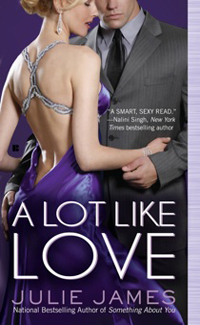
A. Hmm, did I say that somewhere? I mean, sure, I believe that—particularly with my characters, who often use sarcasm to deflect their deeper emotions. I’ll give you an example—in my most recent book, A Lot Like Love, the hero (an FBI agent) and the heroine (a billionaire heiress who owns a wine store) have to pretend to be a couple as part of an undercover sting operation. Now, they say they don’t like each other— and there’s a lot of back and forth banter and sarcasm between them. But the hero stops by the heroine’s wine store one night, and sees that her store is so crowded she hasn’t had time to take a break and eat dinner. So he leaves and comes back with a Portillo’s burger and cheese fries for her. And sure, he grumbles through the whole thing and makes all sorts of wry comments about how billionaire heiresses probably don’t eat cheese fries, and how she’s too thin already, but regardless, the actions speak for themselves—she was having a rough day at work so he went out and got her dinner. Even if he’s sort of cranky about it, it’s still romantic.

6. I think you write the BEST sex scenes of any author I’ve ever read. They are hot without being gross. Care to share tips on how to do a scene that sets the reader’s pulse racing without grossing her out?

A. Thank you! And… I’m kind of wondering what books you’re reading where the sex scenes are gross. Because that’s not good for anyone. : )

Honestly, one way I think you can make a scene instantly hotter is with dialogue. A few good old-fashioned dirty words, when well-timed, can get the pulse racing. Also, one of the key things is that the sex scenes need to be a continuation of the characters’ relationship. Meaning, if the hero and heroine have been trading all sorts of quips and banter throughout the book, well, they should continue that playfulness, that teasing, in the bedroom as well. No matter how descriptive, those scenes should be about the emotions the characters are feeling. Heck, even if it’s a one-night stand, and all the guy is thinking is “Oh my god, yes—I’m getting laid!!, well, that’s the emotion you need to convey in the scene. Sex is intimate, and people are (literally) exposing themselves and making themselves vulnerable to another person, so there needs to be some sense of what’s going on in the characters’ heads.

7. Please talk about the differences between the romance market and the mystery market. Is one more important to you than the other? How are the fans different?

A. Candidly, I’m not that familiar with the mystery market. But I’ve written two romantic suspense novels, and I’m sure there is some crossover. What I can say is that romance readers tend to be extremely voracious readers, and I’m truly appreciative that my books have been so well-received by fans of the genre.

8. Go back in time and talk to Julie before her first book was published. What would you say to her?

A. Oh gosh, this is like the, “What would you say to yourself if you could go back to high school” question. I’m always terrible at these types of questions. I don’t know that I have some great, deep answer so instead I’ll give a practical response. One thing I wished I had known before I was published was how much promotion authors need to do themselves. That would not have changed my decision to write—not at all—but I was pretty clueless after selling my first book when it came to marketing. So writers should be aware that this job does, in fact, involve more than actually writing.

And here’s something perhaps a little deeper: I think I would tell myself that my writing process is my own, and not to worry about how other authors write, or—more specifically, how fast they write. I tend to be a slow writer—I do a book a year in a genre in which many authors write two or more books a year. So I’m constantly reminding myself that it doesn’t matter how fast I go—what’s most important is that I’m pleased with the outcome, regardless of how long it took me to get there.

Learn more about Julie by visiting her website: http://juliejames.com/

Saturday, October 29, 2011

Why Electricians Should Not HONK OFF Their Mystery Writer Clients

Excerpt from my note to my contractor, Rob:

It was a dark and stormy day when they found a body washed up on shore. “Oh, my god, it’s that dreadful electrician,” she thought as she stared down into his white and bloated face with the black electrical tape wrapped around his neck. The fish had eaten his eyeballs out. He lay there half in and half out of the water but he was wearing his gray shirt with his name embroidered happily in red. That—and the fact he wasn’t all the way in or out of the surf--was how she recognized him. He always did things halfway. Two of her driveway lights, the outlets in her garage, and the fixture in her laundry room were all non-functional after his last visit. Of course, his bill was complete. He’d seen to that.


Watching him move back and forth with the force of the tide, she wondered: What happened to him? Could it be another homeowner tired of his complacency and threw him to the sharks off the coast of Jupiter Island? Or had the contractor grown tired of apologizing for the man’s ineptitude and decided to throw in the towel…and the electrician along with it? Was there a more sinister reckoning behind his demise? Perhaps he’d played with the wrong light switch, confused the wires, tripped the circuit breaker one too many times, and POOF!

A crab scuttled up, picked at his flesh and raced back to its hole. A seabird swooped down, landed on the man’s boot, hopped along his leg and pecked at the hairs in his nose.

With a shrug, the woman kicked sand in the corpse’s face and walked on, picking up shells, and thinking, “Hmm. Karma is a booger.”

Friday, October 28, 2011

Happy Halloween! You're Invited to an Online Party!


If there's one holiday that gets my vote for TOTAL CUTENESS, it's got to be Halloween.


HALLOWEEN PARTY ONLINE

On Monday, October 31, we'll be inaugurating my new "fan page" on Facebook. Helping with the festivities will be 12 of my best author buds. Here's the lineup:

9 to 9:30 p.m. EST
Mollie Cox Bryan (Scrapbook of Secrets)
Angie Fox (A Tale of Two Demon Slayers)

9:30 to 10 p.m. EST
Betty Hechtman (Behind the Seams)
Laura DiSilveria (Die Buying)

10 to 10:30 p.m. EST
Julie Compton (Tell No Lies and Rescuing Olivia)
Alan Orloff (The Taste)

10:30 to 11 p.m. EST
Casey Daniels (A Hard Day's Fright)
Vicki Doudera (Killer Listing)
Penny Warner (How to Party Like a Vampire)

11 to 11:30 p.m. EST
Joanna Campbell Slan (Make, Take, Murder)
Margaret Grace (Murder in Miniature)

Special "drop in" guests will be Linda O. Johnston (The More the Terrier) and Monica Ferris (Buttons and Bones).

We'll be giving away books, books, and more books! Just come to my new Facebook Fan Page and click "LIKE" or ask to be my FRIEND. (Which you are, aren't you?)

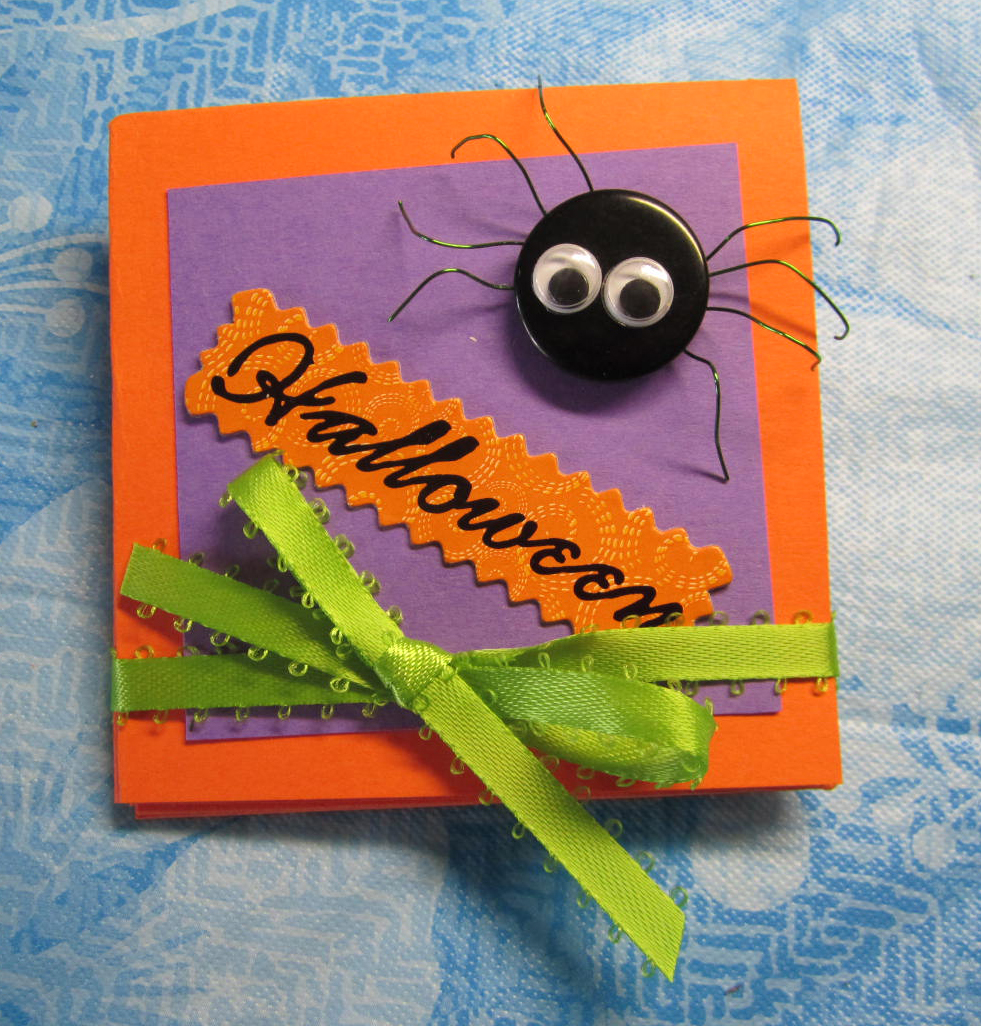
SLAN's SLAM ALBUMS


In the spirit of the spirits, I make these two adorable "slam" albums. Here's a great explanation of how to create the body of the albums: SLAM

Now on to the fun part...

Both "spiders" are just buttons with googly eyes. To one, I attached wire legs. To the other I cut a thin strip of blackish page and folded it accordian-style. That became a leg.

Is this fun or what?

Happy Halloween!

P.S. READY, SCRAP, SHOOT is now available for pre-order!

Thursday, October 20, 2011

I Started (Writing My) Novel to be Polite: An Interview with Julie Hyzy

I don't remember when I met Julie. She's one of those people who is so nice and so easy to be with that she's like a long-lost pal the moment you are introduced. I interviewed her for the Love Is Murder newsletter. Her answers are pure Julie!


**

JCS: Julie, you started as a short story writer convinced she couldn’t finish a book. Tell us about your friendship with Michael Black and the good advice he gave you. Didn’t the two of you also collaborate? How did that work?


click to see a larger versionJH: Absolutely true. I'd dreamed of being a writer since I was a kid, but I had no clue how to go about it. Once my daughters were old enough to get breakfast for themselves, I decided to find out how to get myself published. That was just about ten years ago, but with all the changes in the publishing world of late, it feels like it's been much longer. Anyway, I thought I'd do best if I could find a writing group.

After a couple of detours, I happened upon The Southland Scribes. At that point I'd written a few Star Trek short stories, hoping to get into one of their annual anthologies (I did, eventually, three times!). The Southland Scribes, however, was a novel writing group. They were the only game in town, so I told them I wrote novels. Total lie. As it turned out, they welcomed me warmly and I shouldn't have worried. Mike Black was part of that group at the time. He was the most-learned, most-published member and was extremely generous with all his hard-won information. He encouraged me to write more, and I was thrilled to comply. Heck, getting feedback from him (and from the group) was gold. I'd never had anyone critique me before and I learned so much.

After a while, Mike suggested I try my hand at novel writing. I demurred initially because I didn't think I had the stick-to-itive-ness I'd need to stay with a novel for months. But he kept telling me he thought I could do it and that it was my logical next step. Here's the honest truth: I started a novel to be polite. He'd been so helpful and I'd learned so much that I felt I owed him to at least try. I didn't think I'd finish. He also talked me through outlining a novel, which helped a great deal. Nowadays I sort of outline with a much different process, but back then my outline was my lifeline. I started the novel to be polite, and found -- to my everlasting surprised -- how much I loved the freedom of novel writing. It was so great. As soon as I finished, I wanted to start another. So I did.

Mike and I collaborated on DEAD RINGER. Kind of a fluke how that came about. There was a short story contest going on while we were critiquing one another. I had an idea for it and we worked together on bringing it to life. It didn't see publication then (it did later, elsewhere), but we found the exercise to be fun. We joked around about writing a novel together and we tied the endings of our respective novels together in anticipation of someday collaborating. I think working on that short story had given us so much enjoyment that we decided to go for it sooner than I'd expected (I had a book deadline at the same time so I wound up writing two books at once). Total blast. I know I gave Mike fits because he had a plan in mind for the plot and I tended to deviate often (and wildly). But I think I added a few good things to the mix, too.

We took turns telling the story in first person. Could have been confusing, but I think it turned out okay. It gave me a chance to have Alex St. James, my Chicago news researcher, work with a Mike's Ron Shade. One of our biggest hurdles was the fact that we both had secondary characters named George. But we managed to work around that. And even though I know I caused Mike a great deal of angst during the process, I think we're both very happy with how the final story turned out.

JCS: You’ve offered a few stand-alone novels on Kindle. Why? How’s that going for you? With two successful series, why did you care to add more titles?
My Kindle/Nook titles are mostly my out-of-print titles, brought back to life. Alex St. James went out of print a few years ago and publishing them as ebooks gives me a chance to introduce her to new readers. So far, it's going well. I did put up one original novel, PLAYING WITH MATCHES, under my N.C. (not cozy) Hyzy pseudonym. That one hasn't really found an audience yet. It's slightly harder edged, but I like Riley. She's a private investigator in Chicago, making ends meet by doing background checks for an upscale dating service. I had so much fun writing that one! I hope to add to Alex's adventures first and then continue writing for Riley. You asked why I care to add more titles? Simple answer: I love to write and there are far more stories in my head than I can ever put to paper (or pixels).


JCS:  Where did you get the idea for Ollie, the White House Chef? What was the biggest obstacle you faced in getting that series published? Do you have any concerns that the FBI or CIA will come knocking on your door because you plot against the president? (Okay, a “mythical” president, but still.) How do you do your research?

JH: Everybody asks that question! Here's how it went: You know we have our first ever female executive chef in the White House, right? Her name is Cristeta Comerford. (Usually when I get to that point in answering the question, people start tuning me out. But there's more.) Cozy mysteries, or amateur sleuth mysteries are dependent on the protagonist stumbling over dead bodies or conspiracies on a regular basis.

Where better than in the White House? The thing is, I didn't come up with the actual concept. The late Marty Greenberg did, and he asked me to write it. I wasn't given a series bible or any plot lines, I was given the description: "female White House chef" and told to run with it. So, even though Tekno (Marty's company) owns the copyright, I did come up with Ollie and her cohorts on my own.

After five novels written and the sixth one in the works, Ollie's become a very good friend. Although I can usually predict what she plans to do next, she does have a knack for surprising me.

Do I think the FBI and CIA will come to my door? Probably not. I've done so much research so far, acquiring all sorts of White House books and DVDs, talking to current and former staff members and Secret Service agents, and plugging suspicious search terms into my browser, that if they really thought I might pose a threat, I'd have heard from them by now. Unless of course, I'm under surveillance and I don't even know it. Hmm... I do have two FBI agents living next door. You think that may be a coincidence?


JCS:  Tell us about Grace from your Manor House mysteries. How did you plot such a complicated book? You also manage to put a lot of tension into Grace’s relationships. First with her crush, Jack, and then with Frances, her assistant. Did you plan for that or did it evolve naturally from the characters?

JH: Thank you so much! I'm thrilled to know you enjoyed it.

Grace and the Manor House series is a far more personal series for me than WHChef is. I don't have an awful sister, nor do I have a crush on a man hiding his past, but I did find out about a major family secret after my mother died, much the way Grace did. It was a huge story, but the moment I heard it, I knew it was true. It was as though all the pieces in our family history that didn't fit suddenly came together. Quite a revelation, and having gone through such an upheaval, I'm able to understand exactly what Grace is going through. They say to write what you know... and I have, sort of. I've also written to discover more of what I want to know.

I did plan for a book with complicated relationships. I have lots of plans for Grace going forward, and I think readers will enjoy watching her evolve and become stronger as she learns more about herself and as she interacts with the people in her life. I adore writing for Frances. She's just so much fun and although she isn't based on a real person, she does share qualities with several people I've met in my life. She and Bennett (Marshfield's elderly owner) may just be my two favorite characters in that series.

When the first book came out, a great many people wrote very nice reviews about it. One reviewer didn't like the fact that there were so many characters. Isn't it funny how authors give so much weight to the negative comments? Anyway, I digress. That one reviewer dinged me over the huge cast. I was surprised, initially, and a little hurt (who doesn't get hurt by a bad review?) but then realized that I shouldn't let one person's opinion waylay me from my plans. I created a large cast because I have many, many stories to tell.

JCS:  Your bio is incredibly short on your website. You neglected to tell readers about your work with MWA and your awards. You’ve won an Anthony, a Barry, and a Lovey. Tell us about what it feels like to be so honored. (Julie, you have to be one of the most modest authors around!) You’d written other books before. What “came together” for you to make your White House series so yummy?

JH:  Oh... I have to tell you, the night of the Anthony win was the most magical night ever. That came just two days after winning the Barry Award, and I was flying as high as a person could. That's why I dedicated BUFFALO WEST WING to everyone from Bouchercon 2009. For me, that was truly the best Bouchercon ever. And winning the Lovey... wow. There's nothing quite like being home among so many wonderful people -- people I love -- who show me such warm and wonderful support. I am the luckiest person in the world and I can't thank everyone enough for welcoming me and my characters into the mystery community.

Honestly, being nominated is the true honor. I remember telling everyone that I didn't want Bouchercon 2009 to arrive because then I could no longer call myself an Anthony or Barry nominee. Then it would be over. I had no idea I had any chance of winning these awards.

Magical. Really. That's what it was.

What came together to make all this happen? There's only one answer: Amazing, supportive readers. Without them, I would be nowhere.

JCS:  How many daughters do you have? And how many at home? How do you manage to write and keep up with the demands of a busy household?

JH: We have three fabulous daughters. Robyn is a full-time illustrator who has done work for Alfred Hitchcock Mystery Magazine among others. Sara is in graduate school to become a special education teacher for the visually impaired, and Biz (Elizabeth) is in college now. She recently declared herself an English major, but hopes to pursue theater as well. All three are happy, compassionate, and bright. We're very proud of them. This fall, for the first time, we're empty nesters and the household is suddenly quiet. Far less busy than it's been in the past. That's not to say the girls don't call on mom fairly often -- they do. But I do find myself with more time to write now than I ever had before.

JCS:  Like so many of us female mystery authors, you were hooked on Nancy Drew at an early age. How has that influenced your career? I wonder what will charm the next generation of mystery authors. What do you think?

JH: How has it influenced my career? Oh my gosh, I wanted to BE Nancy Drew. I still do. Writing mysteries allows me to walk in her shoes. Allows me to have adventures and put broken pieces back together and set the world right. I love it! Yes, Nancy was my role model and to this day, I try to fashion my characters after her. No, they don't all have titian hair, or pop off to Machu Picchu on a whim. Nor do they always get along with the local police, but they do share Nancy's world view. They take the high road (most of the time) and try to see the good in people.

Ollie is far more sure of herself (like Nancy) than Grace is, but Grace comes from a different background and hasn't experienced the family support Ollie has always enjoyed. I see Nancy in them both.

As to your other question I, too, wonder who will charm the next generation. I do love Flavia de Luce, but she's young. Nancy had her own car and was a more modern young woman, even in the 1930s when she first burst upon the scene. As much as I enjoyed THE HUNGER GAMES, I don't see Katniss Everdeen as a role model. But Hermoine Granger certainly is. She would be my choice, even without magical skills. Impossible to predict at this point, but certainly fun to guess!


##

Julie Hyzy is the author of the bestselling Manor House Mysteries and White House Chef Mysteries. Visit her at http://juliehyzy.blogspot.com/

Saturday, September 24, 2011

Dangerous Dames Tour

Prepare for a perilously good time when the “Dangerous Dames’’ visit the Raleigh-Durham area for a book tour, Oct. 13-17. Deborah Sharp, Julie Compton, and Joanna Campbell Slan live up to their billing: They kill people for a living -- at least fictionally. In reality, the three nationally known mystery authors are perfectly nice women with families and pets and houses with mortgages. There’s not a homicidal maniac among them, except when it comes to plotting their novels. However, at least one of the Dames confesses to considering murder while undergoing editing. Several appearances are scheduled throughout the area. (See schedule below.)

Most will feature the “Dangerous Dames’’ in a panel discussion. Moderating is Molly Weston, who blogs and lectures about mysteries. An avid Tarheels fan, Weston also edits the Sisters In Crime journal, inSinC.

Here’s more on this lethal literary trio:
Julie Compton mined her training as a lawyer to write her debut, Tell No Lies. Aptly described as part Scott Turow and part Jodi Picoult, the legal thriller earned a starred review from Kirkus, which called it a "taut, tense cautionary tale … with courtroom drama and a surprise ending." Her most recent release, Rescuing Olivia, was praised by Publisher's Weekly as an "intense, entertaining second novel" with a "super-satisfying resolution."

Compton, who left the practice of law to write full-time, now considers herself a recovering attorney. She hopes to never fall off the wagon. She lives near Orlando, Florida. 


Deborah Sharp, a former reporter for USA Today, traded in sad news stories for funny fiction. She sets her ''Mace Bauer Mysteries'' in a sweet-tea-and-barbecue slice of her native Florida. Sharp rode a horse across the state to research her second book, and landed on NBC's Today show in a tacky wedding veil for her third. Mama Sees Stars, her fourth, garnered a starred review in Library Journal: “This zany fourth entry . . . is a feature worthy of the big screen.’’
Sharp and her TV reporter husband, Kerry Sanders, live in Fort Lauderdale. No kids. No pets. They had goldfish once. Turned out badly.

Joanna Campbell Slan is the author of the “Kiki Lowenstein Mystery Series’’ and a dozen other books. Paper, Scissors, Death -- the first book in the mystery series -- was an Agatha Award Finalist. It is also one of Kindle's top 50 bestselling books. Her most recent release in the series is Make, Take, Murder. Slan’s newest mystery series starring Jane Eyre as an amateur sleuth will be released in July 2012, from Berkley. When she isn't traveling with the Dangerous Dames, she divides her time between Washington, DC, and Jupiter Island, Fla.

**
Dangerous Dames Schedule

Friday, October 14, noon — Flyleaf Books, Chapel Hill

7:00 — Page-Walker Cultural Arts Center, Cary, co-sponsored by the Cary Library


Saturday, October 15, 2:00 — McIntyre's Fine Books, Fearrington Village, Pittsboro


Sunday, October 16, 2:00 — Halle Center, Apex, co-sponsored by Eva Perry Library


Monday, October 17, noon — Holly Springs Library (brown bag lunch)

3:00 — West Regional Library, Morrisville
 
And on the fifth day, they collapsed. (Kidding!)